About Equisetum fluviatile L.
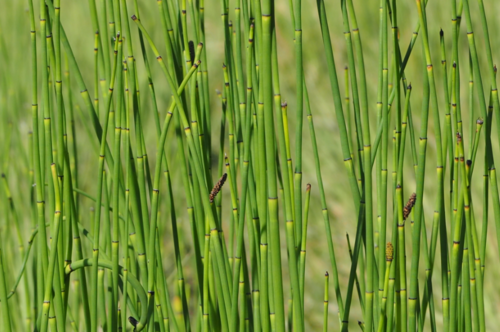
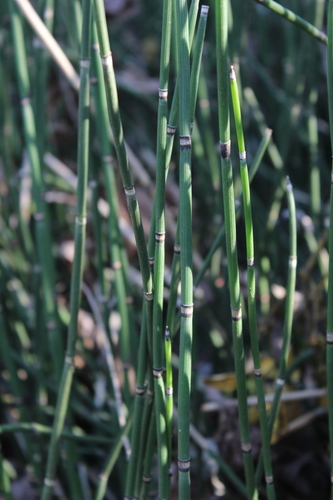
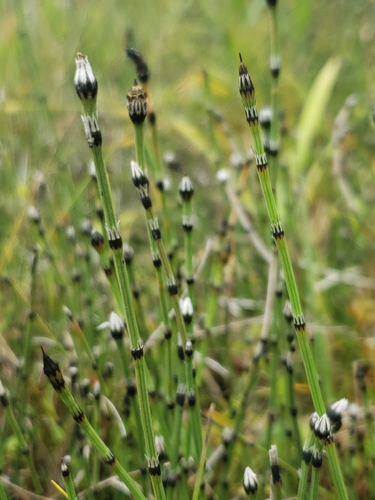
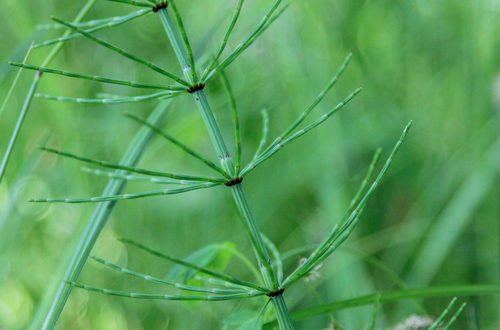
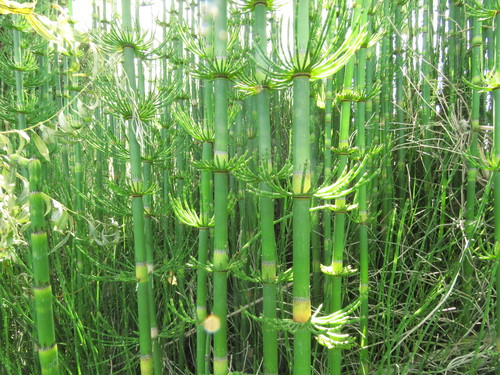
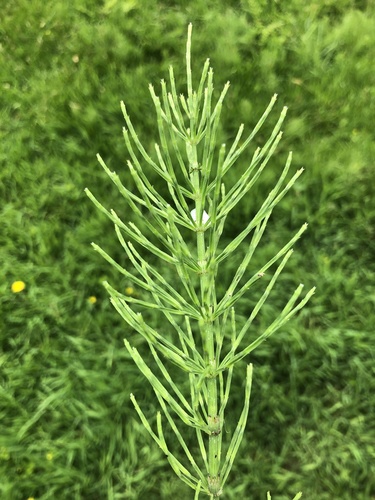
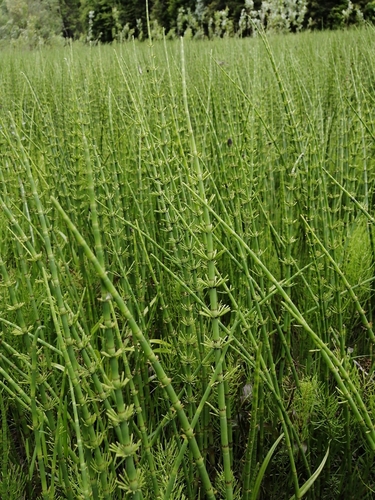
Equisetum fluviatile L., commonly called water horsetail, produces green stems that grow 50–150 cm tall and 2–8 mm thick. Its leaf sheaths are narrow and bear 15–20 black-tipped teeth. Many, though not all, stems grow whorls of short ascending and spreading branches 1–5 cm long; the longest branches are found on the lower middle portion of the stem. These side branches are slender, dark green, and have 1–8 nodes, with a whorl of five scale leaves at each node. Among all horsetails, water horsetail has one of the largest central stem hollows, with 80% of a typical stem diameter made up of hollow space. Its stems pull apart easily at the joints, and both fertile and sterile stems have the same appearance. Water horsetail is most frequently confused with marsh horsetail (E. palustre), which has rougher stems, fewer (4–8) stem ridges, a smaller central stem hollow, and longer spore cones that reach 2–4 cm in length. Water horsetail has a distribution across the entire temperate Northern Hemisphere. Its range extends through Eurasia, south to central Spain, Italy, the Caucasus, China, Korea and Japan; in North America, it ranges from the Aleutian Islands to Newfoundland, south to Oregon, Idaho, northwest Montana, northeast Wyoming, West Virginia and Virginia. It commonly grows in dense colonies along freshwater shorelines or in shallow water of ponds, swamps, ditches, and other sluggish or still water bodies with muddy bottoms. This species is sometimes considered an invasive species because it is very hardy and tends to overwhelm other garden plants unless it is contained. When planting, it is recommended to place its rhizome inside a container to control spread. Water horsetail reproduces both via spores and vegetatively via rhizomes. It primarily reproduces through vegetative means, with the majority of new shoots growing from rhizomes. Spores develop in sporangia within blunt-tipped cones that form at the tips of some stems. These spore cones are yellowish-green and 2.5 cm long. Historically, the ancient Greeks and Romans used this plant medically to stop bleeding and treat kidney ailments, ulcers, and tuberculosis. Ancient Chinese practitioners used it to treat superficial visual obstructions. Carl Linnaeus recorded that reindeer, which refuse ordinary hay, will eat this juicy horsetail; in northern Sweden, it is cut as fodder for cows to increase their milk yield, but horses will not touch it. It has also been used as valuable livestock feed in Finland, where it is considered even better than many cultivated hays. Horsetails absorb heavy metals from soil, so they are often used in metal bioassays.