About Equisetum arvense L.
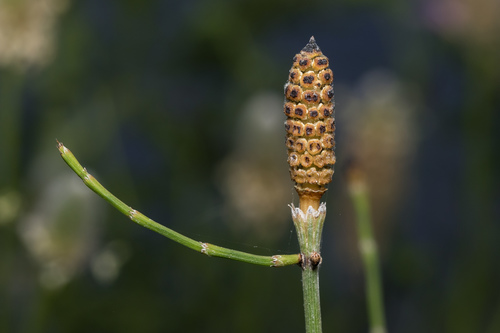
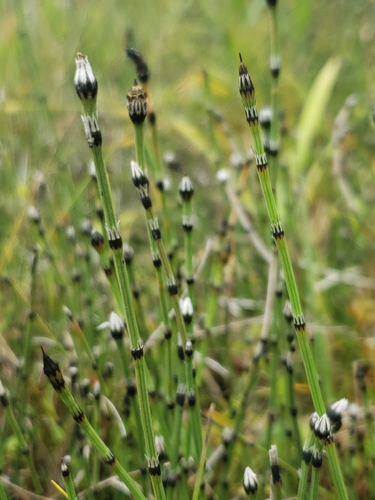
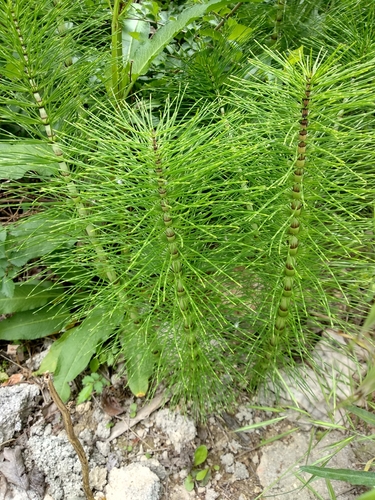
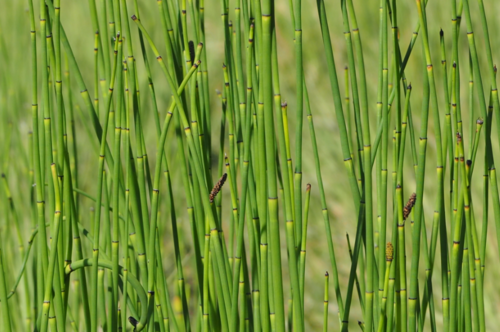
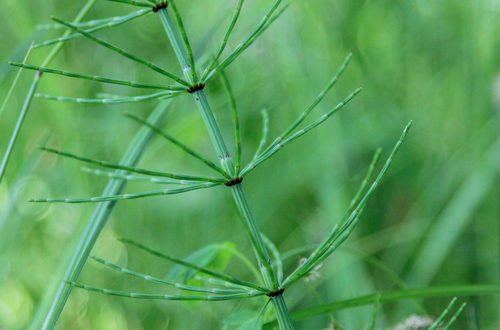
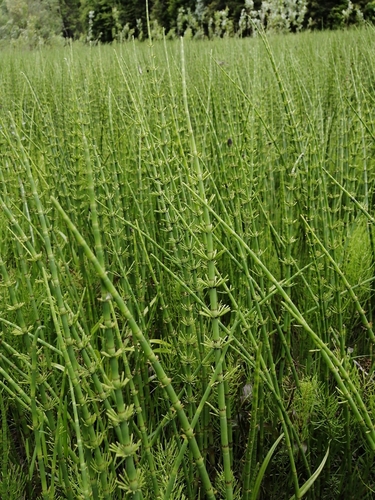
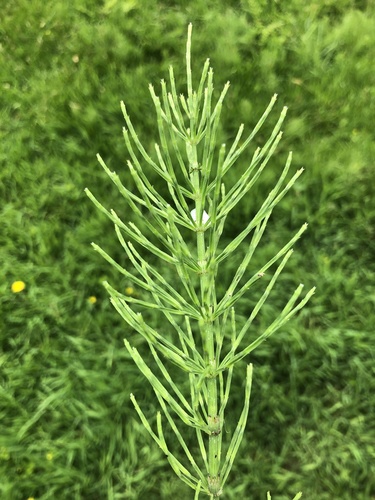
Equisetum arvense L. is a perennial herbaceous plant that spreads via an underground rhizome. The rhizome is slender, felted, branches freely, and produces stem tubers. This species is dimorphic, meaning two distinct growth forms emerge from the same rhizome. Fertile spore-bearing stems first appear in April, and wither and die immediately after releasing their spores. Sterile green stems emerge around the same time, but persist through summer until the first autumn frosts. Sterile stems are either erect or prostrate, growing 10–90 cm (3.9–35.4 in) tall and 3–5 mm (0.12–0.20 in) in diameter, with jointed segments 2–5 cm (0.79–1.97 in) long. Whorls of side shoots grow at the joints of these segments; the side shoots are around 1 mm (0.039 in) in diameter, and some stems can hold as many as 20 segments. The solid, simple branches are either ascending or spreading, with sheaths that bear narrow, tapering teeth. Fertile stems are off-white, succulent in texture, 10–25 cm (3.9–9.8 in) tall and 3–5 mm (0.12–0.20 in) in diameter. They have 4–8 whorls of brown scale leaves and an apical brown spore cone, which is 10–40 mm (0.39–1.57 in) long and 4–9 mm (0.16–0.35 in) broad. Fertile stems are typically precocious and emerge in early spring. E. arvense has changed very little from its Carboniferous period ancestors. It is a non-flowering plant that reproduces via spores. Unusually for herbs, it absorbs silicon from soil. It has a very high diploid chromosome number of 216, meaning 108 chromosome pairs. In terms of distribution and habitat, Equisetum arvense can grow in a very wide range of conditions, tolerating temperatures from below 5 °C (41 °F) to above 20 °C (68 °F), and annual rainfall from 100 mm (3.9 in) to 2,000 mm (79 in). It is commonly found in damp open woodlands, pastures, arable land, roadsides, disturbed areas, and near stream edges. It prefers neutral or slightly alkaline sandy or silty clay loams, especially areas with a high water table, though it can occasionally grow on slightly acidic soils. It is widespread across the Northern Hemisphere, growing as far north as 83° North in North America and 71° North in Norway, Sweden, Finland, and Russia, and as far south as Texas, India, and Iran. It is less widespread in the Southern Hemisphere, but occurs in Argentina, Brazil, Chile, Madagascar, Indonesia, and Australia. It was introduced to New Zealand in the 1920s, and Ella Orr Campbell identified it as an invasive species there in 1949. It is listed on the National Pest Plant Accord, which prohibits its sale, spread, and cultivation. Equisetum arvense is toxic to livestock, especially horses. It is hard to control because of its extensive underground rhizomes, which can penetrate soil to a depth of up to 1.8 m (6 feet). Fire, mowing, and slashing are all ineffective, as new stems quickly grow from existing rhizomes. Some herbicides remove above-ground growth, but regrowth occurs quickly, even though it produces fronds at lower density. This plant contains multiple compounds that can be used medicinally. It is rich in 2-3% silicon, plus potassium, calcium, manganese, magnesium, phosphorus, phytosterols, dietary fiber, vitamins A, E, and C, tannins, alkaloids, saponins, flavonoids, glycosides, and caffeic acid phenolic ester. Its buds are eaten as a vegetable in Japan and Korea in spring; all other Equisetum species are toxic. When growing in polluted conditions, E. arvense may synthesize nicotine. Recent research has found limited evidence for its anti-inflammatory, diuretic, antimicrobial, and antioxidant properties. In traditional herbal medicine, E. arvense has been used in traditional Austrian herbal medicine. It is taken internally as tea, or used externally as baths or compresses to treat disorders of the skin, locomotor system, kidneys and urinary tract, rheumatism, and gout. It was traditionally used externally to treat chilblains and wounds. In Finnish traditional medicine, E. arvense (known in Finnish as peltokorte) has been especially valued for its high silicic acid content. Green summer shoots are dried for use as a remedy, and it has been thought to prevent inflammation and strengthen the skin and immune system. A decoction of E. arvense has been used internally to treat all types of lung disease, and externally to treat rashes and hard-to-heal wounds. In Iran, an infusion of its shoots is considered a remedy for diabetes and obesity.