About Equetus punctatus (Bloch & Schneider, 1801)
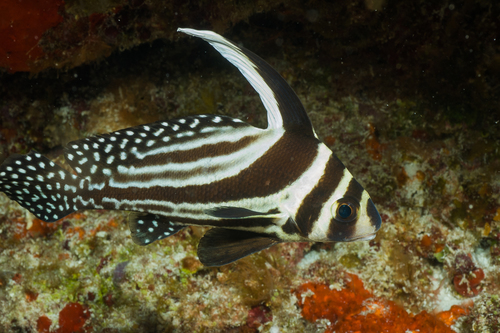
Equetus punctatus, commonly called the spotted drum, has an oblong body that is deep at the head and tapers to a slender caudal peduncle. Its head is low, with a snout that protrudes over the small, horizontal mouth. The spiny first section of the dorsal fin has a short base, is very tall, and holds between 12 and 14 spines. The long-based second section of the dorsal fin is supported by one spine and 45 to 47 soft rays. The anal fin contains 2 spines and 8 soft rays. The entire body is covered in ctenoid scales, and the lateral line extends to the center of the caudal fin. The caudal fin, anal fin, and soft-rayed portion of the dorsal fin are dark with white spotting. The head and spiny first section of the dorsal fin are marked with vertical alternating white and dark brown bars; these bars curve to form longitudinal stripes along the body. Small juvenile spotted drums have a white body with 3 black bars: the rearmost bar runs through the dorsal fin onto the caudal fin. Juveniles also have an oval black spot on the snout and a black stripe on the pectoral fin. The maximum published total length for this species is 27 cm (11 in), while 18 cm (7.1 in) is a more typical size. In terms of distribution and habitat, the spotted drum occurs in the western Atlantic Ocean. Its confirmed range includes the Bahamas, the Florida Keys region of the Gulf of Mexico, the Gulf of Mexico coast of Mexico from Tuxpan, Veracruz, the area from Yucatan to Cuba, and the entire Caribbean Sea. Reports of this species from Bahia, Brazil and Bermuda require confirmation. It is found at depths between 3 and 30 m (9.8 and 98.4 ft), and is associated with coral reefs.