About Eptesicus serotinus (Schreber, 1774)
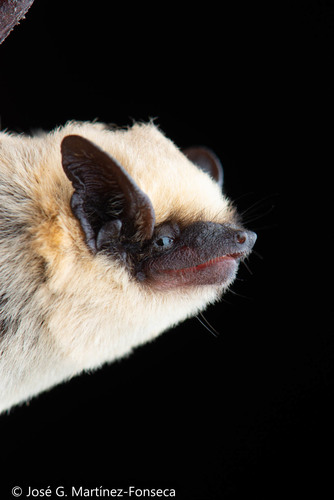
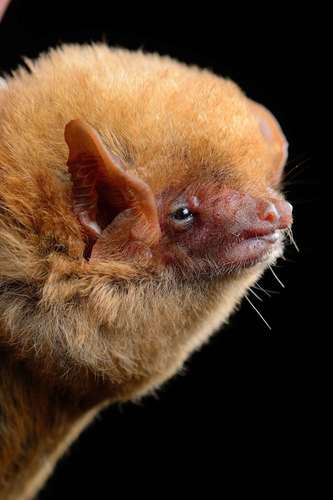
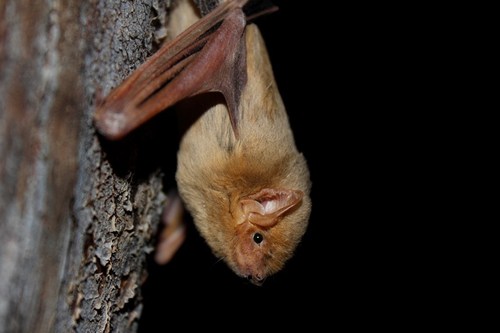
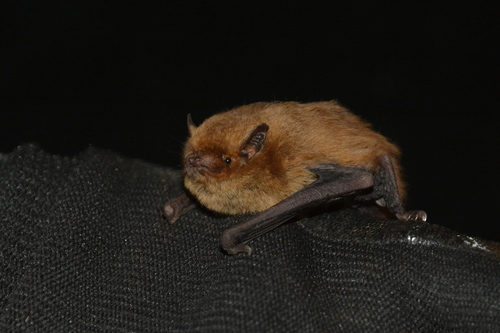
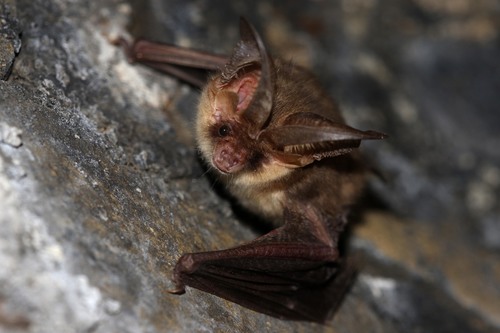
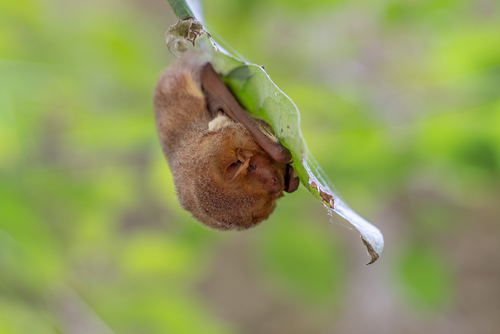
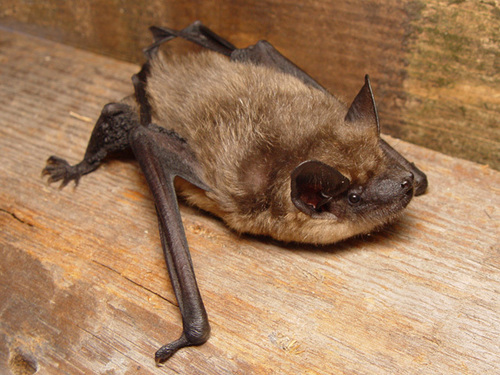
This species is the serotine bat, with the scientific name Eptesicus serotinus (Schreber, 1774). The serotine bat has long fur: its back fur is smoky-brown, while its underparts are a paler yellowish-brown. Its nose and triangular-shaped ears are black, and its wing membranes are dark black or brown. Juvenile serotine bats are darker than adult individuals. This bat is easy to identify in flight, because its combination of broad wings, slow, highly manoeuvrable flapping flight interrupted by brief glides is distinctive. Its tragus is relatively thin and pointed, and is not kidney-shaped like the tragus of Nyctalus bats. The serotine bat has a Palaearctic distribution that falls roughly between 58 degrees and 30 degrees latitude. Its range extends west to southern Great Britain and Spain, east along the Himalayas to northeastern India and along the Tian Shan to southern Mongolia and northern China, and south to Turkey and Iran. It has been recorded as a vagrant on Lanzarote in the Canary Islands. The serotine bat uses a wide variety of habitats, including temperate and subtropical dry forest, maquis, agricultural land, semi-desert, and suburban areas. In 2023, researchers reported that the serotine bat is the first known mammal species to engage in non-penetrative reproductive sex. This reproductive approach appears to be a response to the male’s large penis, which makes up around 22% of the male’s total body length, making penetration difficult. Instead, the male simply holds his penis firmly against the female’s vulva. This form of copulation is unique among mammals, and is more analogous to the cloacal kissing seen in birds.