About Eptesicus fuscus (Palisot de Beauvois, 1796)
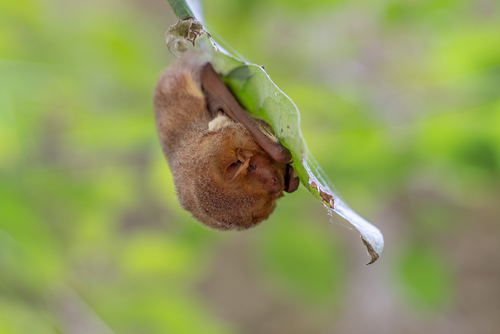
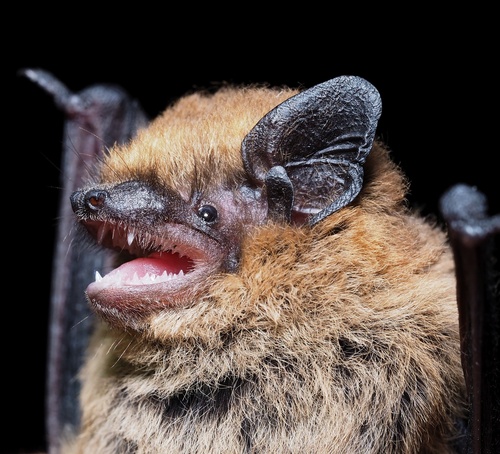
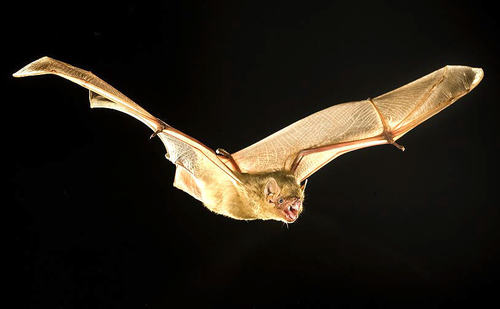
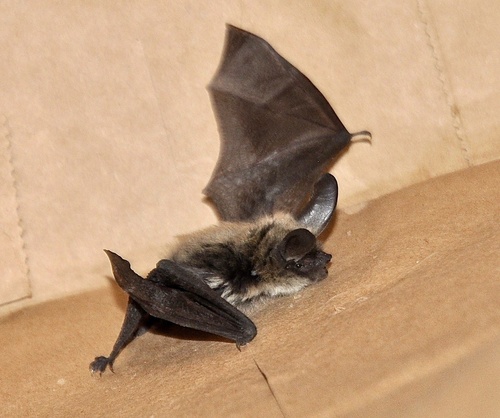
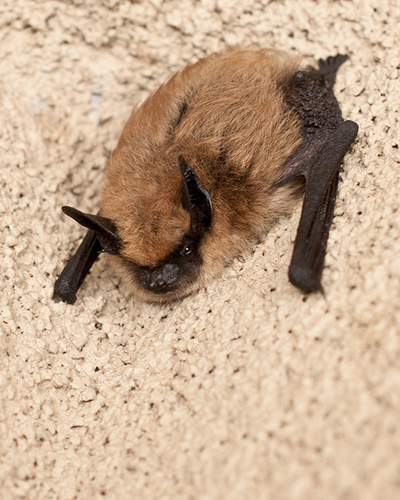
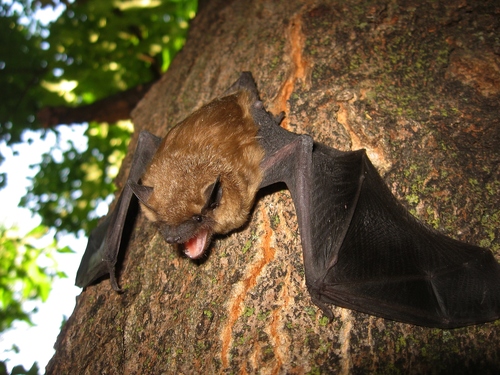
Eptesicus fuscus, commonly known as the big brown bat, is a relatively large microbat. Adults weigh 15–26 g (0.53–0.92 oz), with a total body length of 110–130 mm (4.3–5.1 in), a wingspan of 32.5–35 cm (12.8–13.8 in), a tail length of 47–52 mm (1.9–2.0 in), and hind legs measuring 10 mm (0.39 in). Its forearm is usually longer than 48 mm (1.9 in). It has glossy, reddish brown dorsal fur and lighter brown ventral fur. Its snout, uropatagium (the flight membrane between the hind limbs), wing membranes, and 12–13 mm (0.47–0.51 in) ears are black and hairless; the ears are relatively short with rounded tips. The tragi, the cartilage flaps in front of the ear canal, also have rounded tips. This species has a robust, rounded, somewhat flattened snout: the greatest skull length is approximately 19.25 mm (0.758 in), the braincase is roughly 8.6 mm (0.34 in) wide, and the mandible (jawbone) measures approximately 14.5 mm (0.57 in) long. Its upper incisors are large, with the inner pair being more prominent than the outer pair; the inner upper incisors also have a distinctive secondary cusp. The crowns of the lower incisors are trifid, meaning they have three cusps. Its dental formula is 2.1.1.3/3.1.2.3, giving a total of 32 teeth. Currently, the big brown bat is widespread across North America, ranging from southern Canada and Alaska south to Colombia and Venezuela, and it has been documented throughout the Greater and Lesser Antilles in the Caribbean, including Cuba, Hispaniola, Dominica, Barbados, and the Bahamas. It occurs at elevations between 300–3,100 m (980–10,170 ft) above sea level. It is an environmental generalist that can live in urban, suburban, and rural environments. It is called "the most widespread Pleistocene bat in North America" because it is more represented in Pleistocene fossil records than any other bat species, with an extensive fossil record from more than thirty sites across fourteen US states, Puerto Rico, Mexico, and the Bahamas. Mating season for big brown bats occurs in the fall. After breeding, pregnant females gather into maternity colonies around April. Maternity colonies can range in size from 5 to 700 individuals, and are most frequently 25–75 adults in eastern Canada and the eastern United States. Historically, maternity colonies were most likely located in tree cavities, but in modern human-dominated landscapes, most colonies are now found in buildings. In the eastern United States, females commonly give birth to twins between May and July, while females in western North America only give birth to one pup per year. One dissected female was found carrying four embryos, though it is unlikely all four would have survived to birth. Like most bat species, big brown bats only have two nipples. Newborn pups are blind, helpless, and weigh only 3 g (0.11 oz), but grow quickly, gaining up to 0.5 g (0.018 oz) per day. Pups nurse from their mother for approximately one month; mothers leave pups at the roost while they forage at night. Pups fledge (begin flying) between three to five weeks old. A 2011 study of a Colorado population found an average life expectancy of just over 6.5 years. A 2008 report notes that some banded big brown bats have lived up to 20 years, and some experts have hypothesized the species may be capable of living even longer. In general, males have longer lifespans than females.