About Epomophorus wahlbergi (Sundevall, 1846)
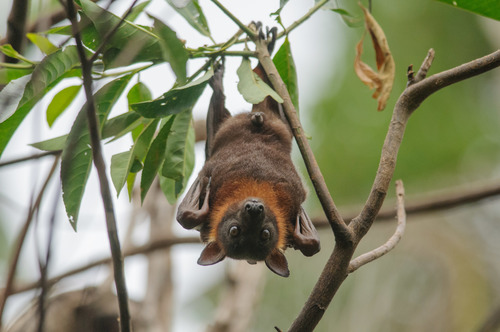
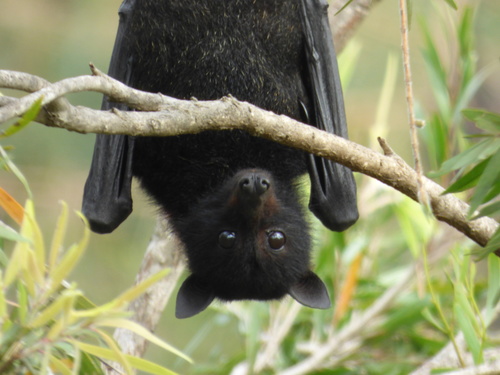
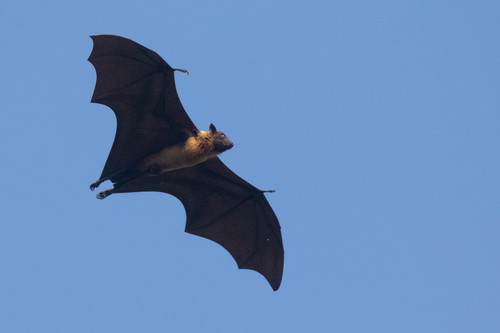
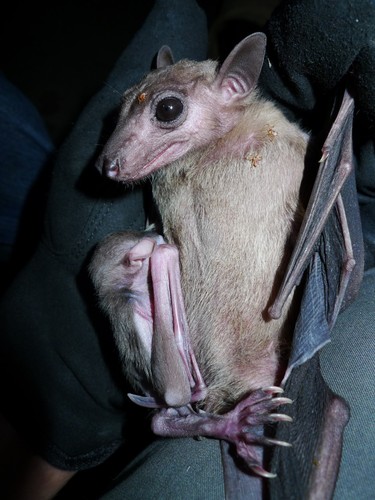
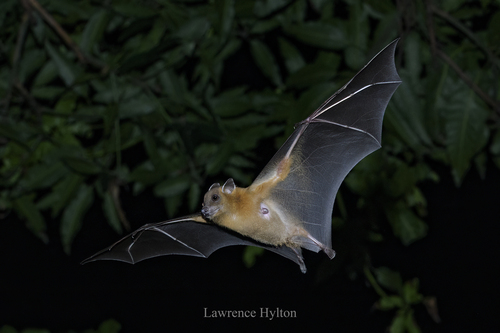
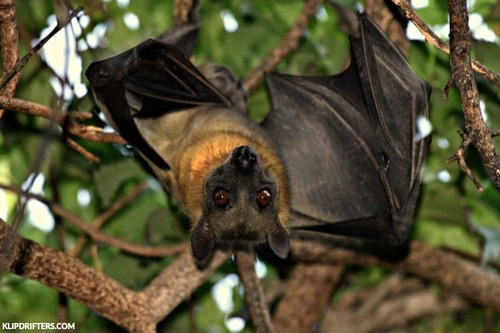
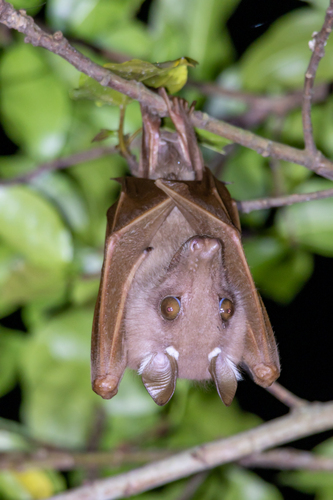
Wahlberg's epauletted fruit bat, Epomophorus wahlbergi, ranges in color from brown to tawny, and has patches of white hair at the base of each ear. Males are generally darker than females. The species gets its name from the erectable hair epaulettes that only males grow around large scent glands. Males can also be told apart from females by air sacs on their neck, which may increase the volume of their courtship calls. Both sexes have scent glands located near the white ear patches. Compared to other bat species, this bat has broad wings. Adult wingspan measures 510–600 mm (20–24 in) for males and 456–540 mm (18.0–21.3 in) for females. Adult body weight falls between 54 and 125 g (1.9–4.4 oz). This species has large eyes, simple oval-shaped ears that lack a tragus, a simple nose, and highly folded, expansible lips. Adult skull length is 44–57 mm (1.7–2.2 in) for males and 41–49 mm (1.6–1.9 in) for females. Species in the genus Epomophorus can be distinguished from other megabats in the family Pteropodidae by their characteristic white epaulettes. Epomophorus wahlbergi can be told apart from other species in its genus by the presence of a single post-dental palatal ridge. This bat is found across southern Africa, where it lives in forest, shrubland, and savanna habitats at altitudes from sea level up to 2,000 m (6,600 ft). Its populations also occur in wooded urban areas, and individuals roost in man-made structures. Outside of breeding activities and parental care, social interaction between these bats typically only happens during roosting. In the mating season, males leave their roost tree, fly to a different tree, and produce frog-like courtship calls while displaying their erected epaulettes. They stay in one spot for up to an hour before moving to another tree. Calling males space themselves roughly 50 m (175 ft) away from other calling males, and produce between 75 and 120 calls per minute. There are two birth periods each year: the first runs from February to March, and the second runs from October to December. The first birth period lines up with the peak in fruit availability that occurs during the rainy season. Gestation lasts 5 to 6 months. Litter size is most often one pup, though two pups are occasionally born. Individuals are typically fully grown by 15 months of age. Females reach sexual maturity at 12 months old, while males reach sexual maturity after 12 months but before 18 months of age.