About Epomophorus gambianus (Ogilby, 1835)
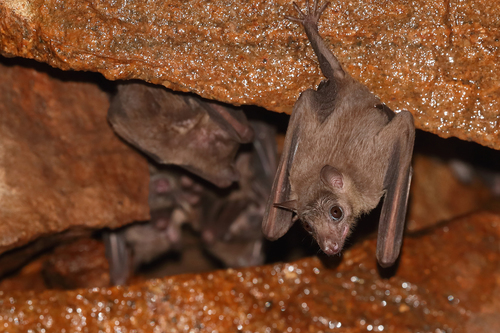
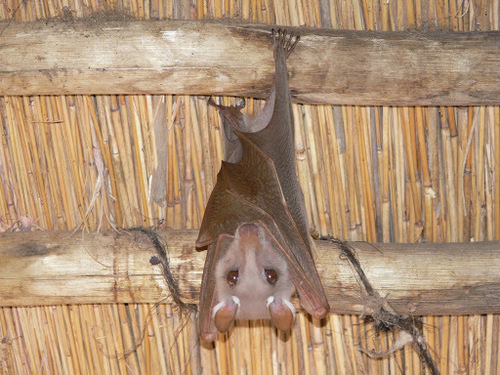
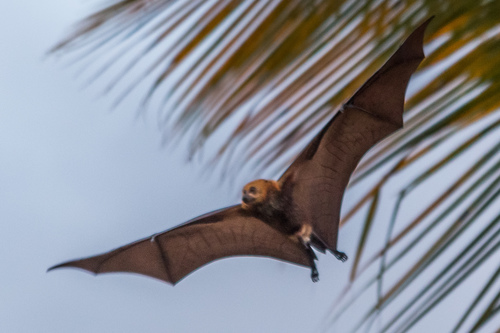
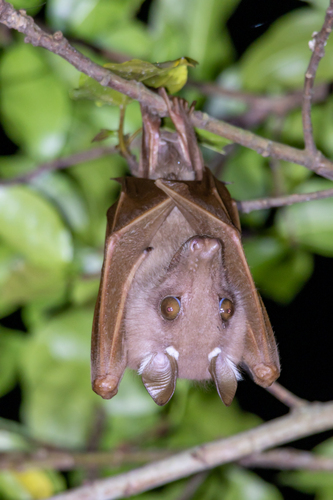
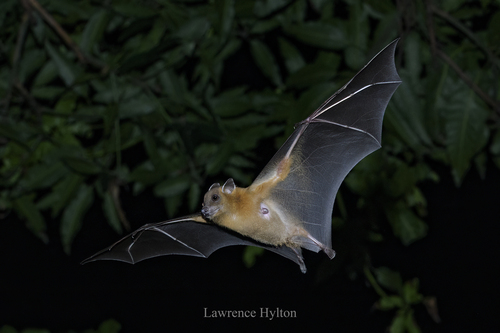
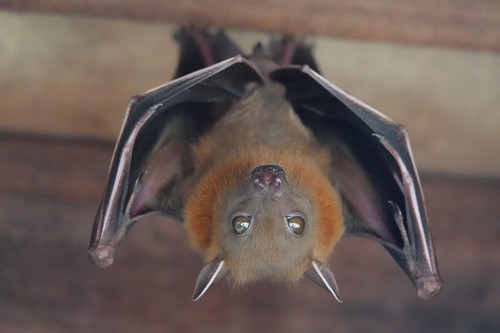
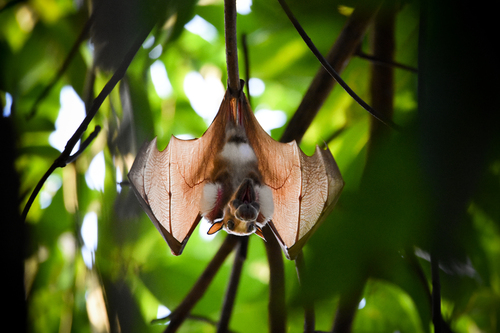
The Gambian epauletted fruit bat, with the scientific name Epomophorus gambianus, is a species of megabat in the Pteropodidae family. It is native to multiple countries across Africa. Its natural habitats include subtropical or tropical dry forests and savanna, and it is an adaptable species that can also live in moist savanna, bushland, partially degraded forest, mangrove, and swamp forest habitats. It typically occurs as a lowland species below 500 meters above sea level, though Ethiopian populations have been recorded up to 2,000 meters above sea level. This species prefers the edges of forests, and roosts individually or in small groups in spots including thick foliage, accumulated roots along stream banks, under the thatch of open sheds, and large tree hollows. It will also roost low in trees during the day, even in well-lit areas close to people, and is commonly found in human agricultural areas with fruit orchards after humans encroached on its natural habitats. During the day, this species roosts alone or spaced apart from other individuals on evergreen trees; at night, it travels in packs of hundreds through African forests. In regions with limited fruiting seasons, Gambian epauletted fruit bats may feed on figs in the rainy season, then fly hundreds of miles to find areas with fruiting trees during the rest of the year. This species has grayish-brown fur, with a white patch at the base of the ear present in both males and females. Both sexes also have small rounded ears and a dog-like muzzle. Their fur and shoulder structures give them the "epauletted" part of their common name. Males are typically larger than females, and males have gland-like pouches in the shoulder skin, surrounded by light-colored patches or fur tufts that create the appearance of epaulettes. These epaulettes are only visible when a male is stressed or sexually stimulated. The species has a head and body length of 125–250 mm (5–10 in), an average male wingspan of around 508 mm (20 in), a body mass range of 40 to 120 g (1.4 to 4.2 oz), and a forearm length of 60–100 mm (2–4 in). It has a tail that is hard to detect beneath the interfemoral membrane. Gambian epauletted fruit bats are very noisy creatures. During mating displays, adult males hang from perches and call, producing moderately loud bell-like 'ping' sounds at 1–3 second intervals. This species displays clear sexual dimorphism, and is polygamous, with breeding seasons falling around April to May and October to November. At night, males travel to mating locations and make courting calls to attract females, while flashing the usually concealed white shoulder epaulettes that are highly visible in night-time lighting. The gestation period lasts around six months, and pregnant females roost separately from males, usually giving birth to one young at a time. While fertilization happens immediately after mating, embryonic development is delayed. This delay ensures birth occurs during a season when food is abundant enough to support the high energy needs of lactating females, and also allows mating to take place when both sexes are in good physical condition with access to plenty of food. Newborns grow rapidly, with different body parts growing at different rates. At birth, thumbs and hind feet are nearly adult-sized and grow very little, while the forearm and other wing-supporting bones enlarge quickly, resulting in an adult wing area 10 times larger than at birth. Young bats gain weight rapidly until weaning, but after switching from mother's milk to fruit, they lose body weight and use the fat reserves built up during nursing. Newborns have specialized milk teeth that do not help with eating solid food, but allow them to attach to their mother's teats. Milk teeth are shed and permanent teeth emerge at around the same time that young bats learn to fly and start eating fruit. For a small mammal, this species has a long lifespan. Most individuals can live up to 28 years, with an average lifespan of around 21 years. The reason for this bat's long lifespan is not definitively known, though some researchers hypothesize it is connected to the calpain content of neurons. Populations of this species face multiple threats. They are harmed by pesticides used on fruit, human disturbance, and over-collecting that occurred in the past, but the single largest threat to the species is habitat destruction.