About Epitonium clathrus (Linnaeus, 1758)
This species has the scientific name Epitonium clathrus (Linnaeus, 1758).
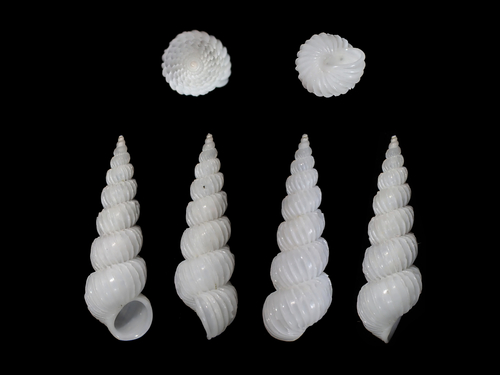
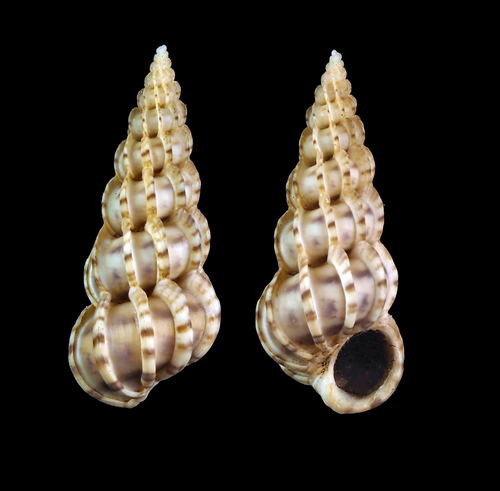
Description of the shell: The cone-shaped shell grows to a height of 35 mm. It is shiny white to cream in color, and often marked with brown spots. Seven thick, very distinct costae (spiral ribs) spiral around twelve to fifteen whorls. These convex whorls frequently have two or three purple bands, which are most visible when they cross the lamella of the outer lip. The protoconch is usually blunt. The aperture is entire and rounded, and its top aligns with a suture. There is no umbilicus. The operculum is horny and paucispiral.
Description of soft parts: Data for this section is compiled from George Washington Tryon (1887) and Johannes Thiele (1929). The short foot is truncated at the front, and extends far forward of the head. The long tentacles are narrow and positioned close together. The eyes are located at the base of the tentacles. The mantle margin is simple, and contains a rudimentary siphonal fold. The radula is wide and more or less bent at its end. The radular teeth are elongate, and either hook-shaped or needle-shaped, with many teeth arranged in a series. This species is hermaphroditic.
Distribution: The common wentletrap Epitonium clathrus is very common along the eastern Atlantic coast, from the North Sea north to Norway, as well as in the Mediterranean and the Black Sea. Live specimens of this species have only rarely been observed. It does occur in the Baltic Sea, where it has become a vulnerable species.