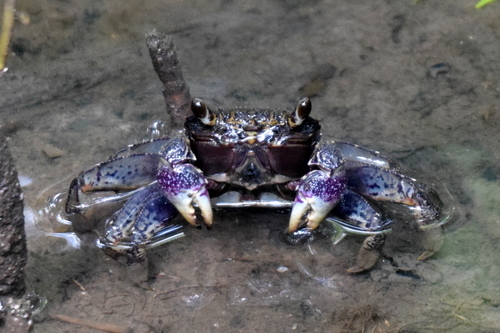
About Episesarma versicolor (Tweedie, 1940)
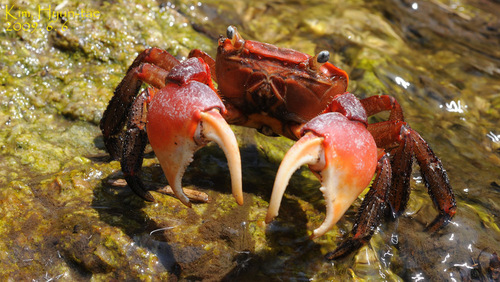
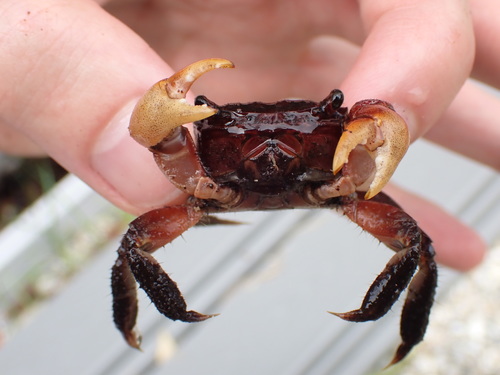
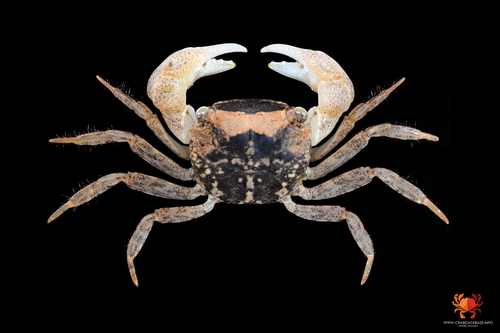
The genus Episesarma includes some of the largest sesarmid crabs. Episesarma versicolor can be distinguished by its violet chela (claw) with a white tip. Males reach a maximum length of 5 cm. The carapace is square-shaped, relatively flat, and ranges in color from brown to brownish grey. Compared to other members of the genus Episesarma, the first gonopod of male E. versicolor has a narrower and shorter tip. The dorsal portion of the dactylus has 65 to 80 densely packed projections called tubercles. These bony, spine-like structures are more pronounced in males, and similar to tubercles found in other crab species, they appear to function as stridulatory organs that generate sound. An additional set of around 40 bony, spine-like tubercles is also present; these are also more pronounced in males, and are likewise thought to be stridulatory organs for producing sound. This species is a mangrove-dwelling crab, found across Southeast Asian locations including Southern China, Hong Kong, Indonesia, Malaysia, the Philippines, Singapore, and Thailand, as well as northern Australia, and South Asian countries including Bangladesh, India, and Sri Lanka. This species is widely distributed across mangrove regions, where it inhabits burrows at the bases of trees, or sometimes burrows in mounds created by Thalassina lobsters. Mangroves have high biodiversity and provide a species-specific niche for this crab that reduces interspecific competition for food and other resources. Compared to other species in the genus Episesarma, E. versicolor prefers mangrove forest habitat over the Thalassina mound system. Like most crabs, E. versicolor has separate male and female sexes. Mating generally begins with a courtship ritual that uses both olfactory and tactile cues, followed by indirect sperm transfer.