About Epipogium roseum (D.Don) Lindl.
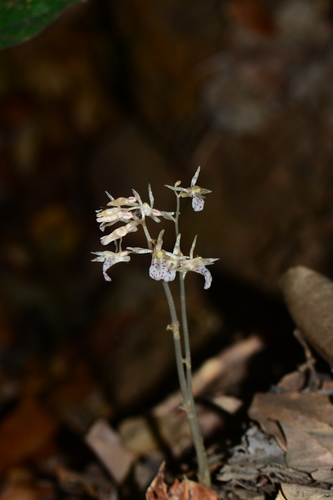
Epipogium roseum (D.Don) Lindl. is a leafless, terrestrial mycotrophic herb. It has a fleshy underground rhizome, and a fleshy, hollow, dull yellow flowering stem that grows 200–600 mm (8–20 in) tall. It produces between two and sixteen resupinate cream-coloured, yellowish or pinkish flowers. Each flower is 10–12 mm (0.4–0.5 in) long, and has an unusually swollen ovary. The sepals are linear to lance-shaped, measuring 8–11 mm (0.3–0.4 in) long and 2–3 mm (0.08–0.1 in) wide. The petals are often slightly shorter and wider than the sepals. The dorsal sepal and petals are joined at the base and spread weakly. The labellum is egg-shaped, 11–14 mm (0.4–0.6 in) long and 4–5 mm (0.16–0.20 in) wide, with a spur at its base. Flowering occurs from December to March in Australia, and from April to September in China. Plants emerge a few days after the first heavy rains of the wet season, and set seed within a few days of emerging. This species grows in high rainfall habitats, particularly rainforest, on decaying wood. It is distributed across many regions and countries, including China, India, Indonesia, Japan, Laos, Malaysia, Nepal, the Philippines, Sri Lanka, Thailand, Vietnam, tropical Africa, New Guinea, Australia, and several Pacific islands including the Solomon Islands. In Australia, it occurs between the Windsor Tablelands in Queensland and the Macleay River in New South Wales.