About Epipogium aphyllum Sw.
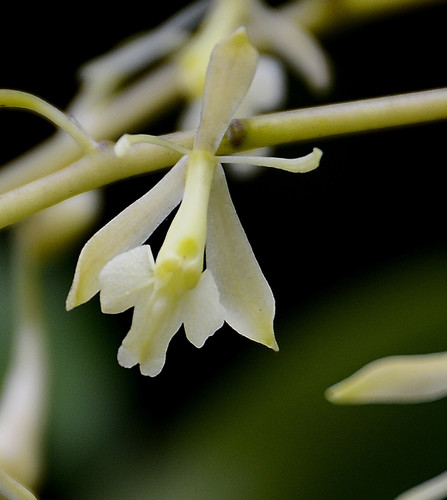
Epipogium aphyllum, commonly called the ghost orchid, is a hardy mycoheterotrophic orchid that does not produce chlorophyll. Across most of its range, it is a rare member of the orchid family Orchidaceae. It is well known for its unpredictable appearance; in many locations, it has only been observed a single time. It grows on base-rich soils in beech, oak, pine, and spruce forests across Europe and Asia. It is a rare, critically endangered plant in Britain, where it was once thought to be extinct across most of its former range. Its presence was re-confirmed in areas where it was believed extinct in 2009 and 2024. This species is protected in many regions, and removing plants from their habitat or disturbing them, even for scientific study, is considered a serious offense in many jurisdictions. Because these plants are exceptionally rare, they should never be removed from their natural habitat or disturbed. In 1926, the British Museum asked Welsh botanist Eleanor Vachell to look into a reported sighting of the ghost orchid in England. For many years after, the Welsh National Herbarium at Amgueddfa Cymru (National Museum of Wales) only held a small rhizome collected by Vachell on 29 May 1926. Epipogium aphyllum has an extremely wide distribution. It is widespread across most of the temperate zone of northern and central Europe, Russia, and northern Asia, ranging from Spain to Kamchatka and south as far as the Himalayas. Record hotspots for the species extend from the boreal regions of Scandinavia south to the Pyrenees, the Vercors Massif, northern Greece, and Crimea. The species was first documented on Mount Željin in central Serbia in 2023, and its IUCN conservation status in Serbia is estimated as Endangered (EN). In Asia, Epipogium aphyllum is classified as vulnerable in Mongolia, endangered in Japan and China, and not considered threatened in North and South Korea. A 2011 IUCN 3.1 assessment rated the species Least Concern (LC) across Europe due to its low overall extinction risk, but it remains exceptionally rare in wild habitats. It is protected or listed on the IUCN Red List in nearly 56 countries. All wild populations of this species occur in areas that typically have cold winters. The plant's rhizomes are densely colonized by basidiomycete fungi that have clamp connections and dolipores; these are gilled or pore-forming mushroom species that normally form mycorrhizal associations with the roots of coniferous trees. In northwestern Russia, Epipogium aphyllum only emerges above ground in July. Its flowering period takes place in late July and early August. Isolated individual plants have been recorded flowering as late as September in rare exceptional cases.