About Epipactis helleborine (L.) Crantz
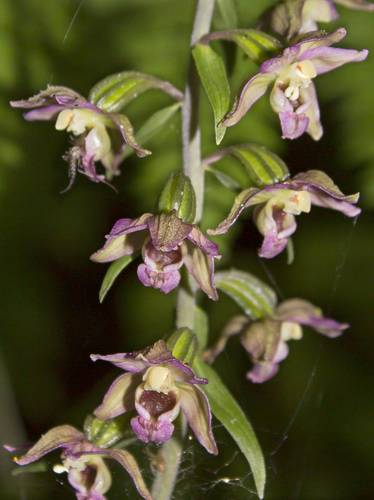
Epipactis helleborine (L.) Crantz can reach a maximum height of 1 meter (3 feet 3 inches) or taller when growing in good conditions. It has broad, dull green, flat leaves with prominent strong ribs. Its flowers grow in long, drooping racemes: the sepals are dull green, the upper petals are shorter than the sepals, and the lower labellum is pale red and much shorter than the upper petals. White, achlorophyllous individuals of this species have been documented; these achlorophyllous forms are typically shorter, and can be as small as 17 centimeters tall. This species flowers from June to September. This orchid is widespread across most of Europe and Asia, ranging from Portugal to China, and also occurs in northern Africa. Within the United Kingdom, it is widespread and common in England and Wales, absent from most of Scotland, and scattered across Ireland. It is an introduced, widely naturalized species in North America, found mostly in the Northeastern United States, eastern Canada, and the Great Lakes Region, with scattered populations in other parts of the continent. In the United States, it is sometimes called the "weed orchid" or "weedy orchid", and it continues to spread to new areas across the country, including Michigan, Wisconsin, and the San Francisco Bay Area. Epipactis helleborine grows in woodlands and hedge-banks, often located close to paths near human activity. It is one of the European orchids most likely to be found within cities, with established populations in places like Glasgow, London and Moscow, and it is sometimes spotted beside car parks. It is well known for successfully colonizing human-made and anthropogenic habitats such as parks, gardens and roadsides. Roadside populations of this orchid have distinct characteristics, including larger plant size and a greater capacity to produce flowers. Pollinator diversity is higher in anthropogenic habitats than in native habitats for this species, with pollinators including members of Syrphidae, Culicidae and Apidae, and these pollinators visit flowering sites more often in anthropogenic areas. Both pollinator visitation rates and reproductive success are higher in larger orchid populations, as larger populations are more attractive to pollinators. This orchid species is pollinated by multiple species of Hymenoptera, especially the common wasp, as well as other species in the genera Vespula and Dolichovespula. Its flowers produce sweet nectar that attracts wasps, and this nectar has an intoxicating effect on the wasps. A study of eight Epipactis helleborine populations in Lower Silesia, Poland (central Europe) found that their nectar contains naturally occurring oxycodone and another narcotic-like opioid in very small quantities. Epipactis helleborine requires a mycorrhizal symbiosis to germinate successfully, and mature plants remain partially dependent on their associated fungal partners. The species is not particularly selective about which fungal species it associates with. Fungi found associated with its living roots include Tuber, Helotiales, Peziza, Leptodontidium, Hydnotrya and Wilcoxina. It has been suggested that the presence of this orchid in a woodland indicates that edible truffles grow there, but this is not always true.