About Epinephelus tukula Morgans, 1959
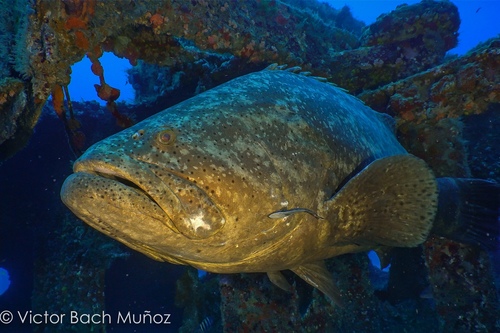
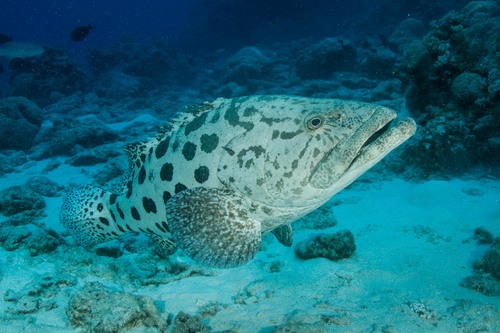
The potato grouper (Epinephelus tukula) has a standard length that is 2.9 to 3.5 times its body depth. It has a slightly convex area between its eyes, and a straight dorsal profile on its head. Its preopercle is rounded or subangular, with slightly enlarged serrations at the corner, while the upper margin of the gill cover is straight. The dorsal fin has 11 spines and 14 to 15 soft rays, and the anal fin has three spines and eight rays. The membranes between the dorsal fin spines are notched, and the caudal fin is rounded. This species is overall pale brownish-grey, covered in large, widely separated dark blotches. Dark lines radiate out from the eyes, and small dark spots appear on the fins. It is a large, robust grouper that reaches a maximum published length of 200 centimetres (79 in) and a maximum weight of 110 kilograms (240 lb). The common name comes from the dark body blotches, which are thought to resemble potatoes in shape.
Potato groupers have a wide distribution across the Indian and Pacific Oceans, but they are uncommon to rare in most regions. They are most common along the coast of eastern Africa, from the Red Sea to KwaZulu-Natal in South Africa, and around the Indian Ocean islands of Madagascar, Seychelles, Mauritius, and Réunion. They also occur off western India and Sri Lanka, extending east into the Pacific Ocean as far east as the Solomon Islands, north to southern Japan, and south to Australia. This species has not been recorded in the Persian Gulf. In Australia, it ranges from Shark Bay in Western Australia along the northern coasts to Moreton Bay in Queensland, and it is also found on the Great Barrier Reef.
This species inhabits coral reefs, occurring in reef channels and around seamounts in areas with strong currents. Juveniles prefer shallow water and are often found in reef tidal pools, while adults live at depths between 10 and 150 metres (33 and 492 ft). Potato groupers are solitary and typically stay within their home ranges. They are ambush predators that feed on small rays, crabs, fish, squid, octopuses, and spiny lobsters. They use coral as cover to hide from prey, and lunge to swallow prey whole when prey is within range. They are aggressive territorial fish with relatively small home ranges. They reach sexual maturity at a length of 90 to 99 centimetres (35 to 39 in) and a weight of 16 to 18 kilograms (35 to 40 lb), at approximately 12 years of age. Aggregations of smaller fish have been observed, but it is not confirmed whether this species aggregates to spawn. Captive individuals have been induced to change sex from female to male, so like many other groupers, the potato grouper may be a protogynous hermaphrodite.