About Epinephelus quoyanus (Valenciennes, 1830)
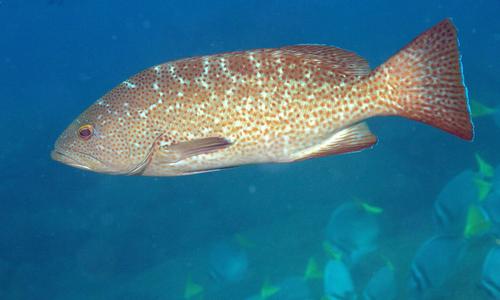
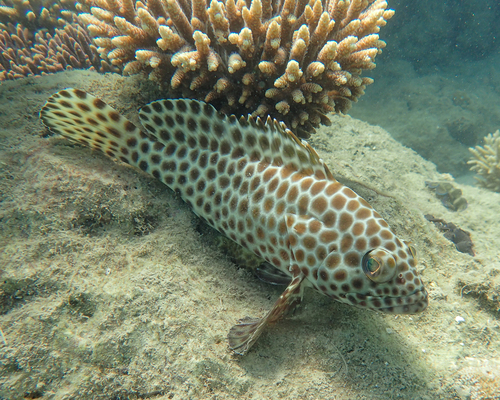
Epinephelus quoyanus, commonly called the longfin grouper, has a body whose standard length is 2.8 to 3.2 times its depth. The dorsal profile of the head is smoothly curved. The preopercle is rounded or subangular, and the gill cover has a nearly straight upper edge. The dorsal fin has 11 spines and 16 to 18 soft rays, while the anal fin has 3 spines and 8 soft rays. The caudal fin is rounded, and the pectoral fin is around twice the length of the head. The head, body, and fins are overall whitish, marked with many large, closely set dark brown to blackish spots that range from hexagonal to roundish in shape. On the upper parts of the head and body, the spots are closer together and form a reticulated pattern, while on the lower parts of the head and body the spots are more widely spaced and less well defined. Similar dark spots appear on the dorsal, anal, and caudal fins. There are two dark bands on the breast that join underneath the pectoral fin and almost join at the gill slit, creating an isolated pale patch on the ventral section of the breast. A second pale area lies between the upper dark band and a dark blotch that normally covers most of the base of the pectoral fin. Irregular dark brown bands and blotches are present on the throat and the ventral surface of the breast. The dark spots on the head get smaller closer to the snout, but are always noticeably larger than the nostrils, and a squarish white or pale area sits on the cheek at the rear end of the upper jaw. The rear margin of the pectoral, anal, and caudal fins is mostly dusky with faint dark spots, while the leading edge of the pelvic fins has a white line and a broad blackish submarginal band. This species reaches a maximum total length of 40 centimetres (16 in).
The longfin grouper is native to the Indo-West Pacific, particularly the Indomalayan region. In the Indian Ocean, it has only been recorded from the Andaman Islands and waters off Australia. In the Western Pacific Ocean, its range extends from Japan and South Korea in the north, south to Australia, and east as far as the Solomon Islands. In Australia, it is distributed from Shark Bay in Western Australia along the northern coast as far south as northern New South Wales, and includes the islands of the Great Barrier Reef.
The longfin grouper inhabits silty reefs in coastal waters at depths of less than 50 metres (160 ft). It is a sedentary species that feeds on worms, smaller fish, and crustaceans. This species is a protogynous hermaphrodite: females become sexually mature at around 24 centimetres (9.4 in) in length, when they are 1.8 years old. They change sex to become males once they reach a total length of around 33 centimetres (13 in). The species' long, fleshy pectoral fins appear to be used to support the fish's body when it rests on the substrate.