About Epinephelus polyphekadion (Bleeker, 1849)
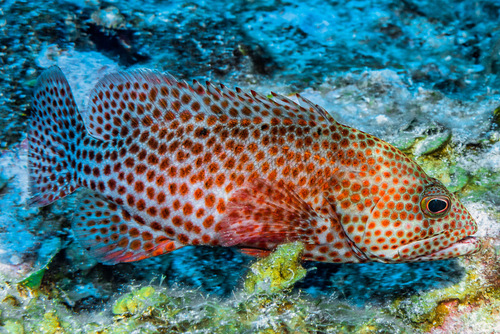
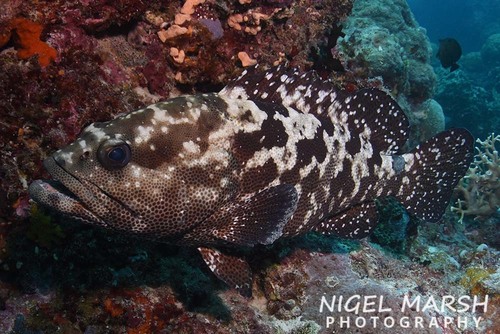
The camouflage grouper, Epinephelus polyphekadion (Bleeker, 1849), has a standard length that is 2.7 to 3.1 times its body depth. The region between its eyes is flat, and the dorsal profile of its head is convex. Its preopercle is rounded, with slightly enlarged serrations at its corner, and the upper edge of its gill cover is distinctly convex. The dorsal fin has 11 spines and 14 to 15 soft rays, while the anal fin has 3 spines and 8 soft rays. The fourth dorsal fin spine is longer than the other spines, and the membranes between the dorsal fin spines are slightly notched. The caudal fin has a rounded shape. This species is pale brown and covered in small dark brown spots. Its upper body is whitish, broken by large dark blotches that look like diagonal bands, and it has a dark saddle-shaped blotch on the upper part of the caudal fin base. Camouflage groupers are frequently misidentified, and they are often confused with Epinephelus fuscoguttatus. The species reaches a maximum total length of 90 centimetres, or 35 inches. The camouflage grouper has a broad distribution across the Indo-Pacific. Its range stretches along the East African coast from the Red Sea south to Mozambique, east across the Indian Ocean where it occurs around the Comoros, British Indian Ocean Territory, Mauritius and the Seychelles, and continues east into the Pacific Ocean as far as French Polynesia. In the Pacific, its range extends north to southern Japan and south to Australia. In Australia, it is found from Shark Bay and Scott Reef in Western Australia, around the northern coast to One Tree Island in Queensland, and also occurs around reefs and islands in the Coral Sea and the Tasman Sea. The camouflage grouper inhabits shallow water lagoons and outer reefs in coral-rich areas, and it is more abundant around islands, particularly atolls. It favors reefs that have caves and crevices it can swim through. It is typically found in small schools, though it can also be solitary, and it prefers clear water. This predatory species feeds mainly on crustaceans, especially portunid crabs, and fishes; it occasionally preys on cephalopods and gastropods. It is thought to be gonochoristic, and hermaphroditism has not yet been demonstrated for this species. It reaches sexual maturity at around 4 years of age and can live up to 42 years. This species forms spawning aggregations, and individual fish follow regular migratory routes to reach these aggregations.