About Epinephelus morio (Valenciennes, 1828)
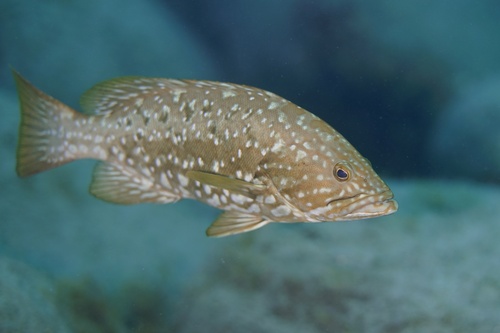
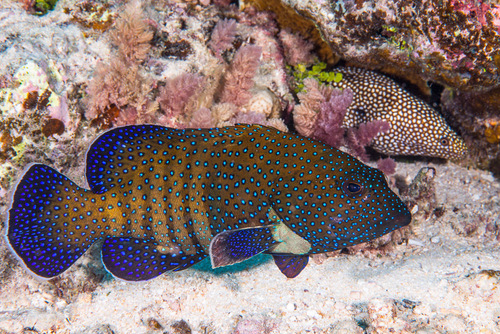
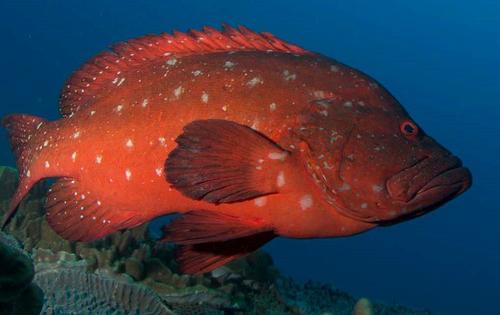
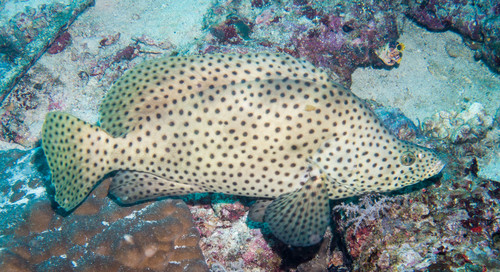
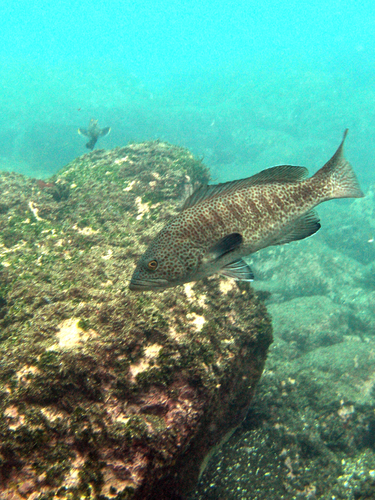
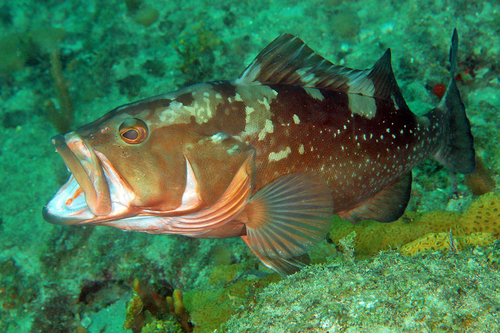
Epinephelus morio, commonly called the red grouper, has a standard length 2.6 to 3 times its body depth. Its preopercle is subangular, with slightly enlarged serrations at its angle, and the upper edge of its gill cover is straight. The gill cover bears three flat spines, with the central spine being the longest of the three. The dorsal fin holds 11 spines and 16 or 17 soft rays, while the anal fin has three spines and eight soft rays. Pectoral fins are longer than the pelvic fins, the caudal fin is truncate, and pelvic fins insert posterior to the insertion point of the pectoral fins. Red groupers are dark reddish brown on the upper head and body, shading to paler pink on the underparts. Their bodies are marked with lighter spots and blotches, and their fins have darker margins. This species has a maximum published total length of 125 centimetres (49 in), though individuals are more commonly found at around 50 centimetres (20 in), and it has a maximum published weight of 23 kilograms (51 lb). Red groupers are highly territorial, and when aggravated or engaged in spawning activities, they can change their coloration patterns very rapidly: the head or other body parts can turn completely white, and existing white spots become more intense. The typical range of the red grouper covers coastal areas of the western Atlantic, stretching from southern Brazil to North Carolina in the United States, and includes the Gulf of Mexico and Bermuda. It occurs on wide continental shelves and is classified as a neritic species. The red grouper is a demersal, largely sedentary species. It has an extended pelagic larval stage that lasts around 40 days, before juvenile fish settle into shallow coastal hardbottom habitat. Juveniles stay in inshore waters for 4 to 5 years, then migrate to offshore hardbottom habitat, particularly the edge of the continental shelf, as adults. Spawning takes place offshore between January and June, peaking in May. While red groupers feed primarily on benthic invertebrates, they are opportunistic feeders within reef communities. Their common diet includes xanthid and portunid crabs, juvenile spiny lobster, and snapping shrimp, with occasional fish. Red groupers act as habitat engineers on the seafloor. They actively excavate pits in the sediment, starting digging as soon as they leave the planktonic stage and continuing this activity throughout their lives. They use their caudal fin and mouths to clear debris and sediment from rocks, creating exposed surfaces where sessile organisms such as sponges, soft corals, and algae readily settle. Exposing this rocky structure also attracts a wide variety of other species, including mobile invertebrates and a diverse community of other fishes ranging from gobies and butterflyfish to grunts and snappers. By 2008, the invasive lionfish Pterois volitans had begun invading red grouper habitat, ranging from Florida Bay to the Florida Keys and offshore to Pulley Ridge, a mesophotic coral reef located on the West Florida Shelf west of the Dry Tortugas. Lionfish are known as highly effective predators of small reef fish, so scientists are actively interested in determining how far this invasion alters the functional dynamics of the communities associated with red grouper excavations.