About Epinephelus merra Bloch, 1793
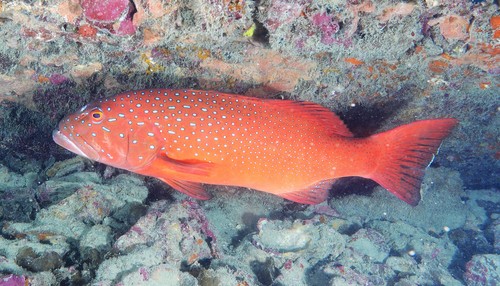
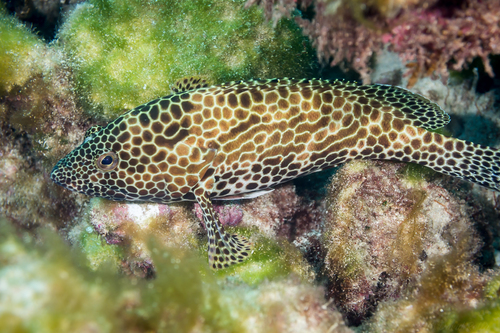
Epinephelus merra (Bloch, 1793), commonly called the honeycomb grouper, is one of the smaller species in the genus Epinephelus, reaching a maximum known total length of 32 centimetres (13 inches). This species has a long dorsal fin with 11 spines, 15 to 17 soft dorsal rays, and 8 soft anal rays. Its body is stocky with an oval outline, and ranges in color from ochre to light brown. The body is covered in small brown hexagonal markings separated by pale gaps; these markings are arranged along irregular darker diagonal bands that form a network pattern, which gives the species its common name. These hexagonal spots are also present on all of the fish's fins. The caudal fin is rounded, the interorbital area is flat, the dorsal profile of the head is convex, and the eyes are globular with red-brown to black pupils. The lower jaw is longer than the upper jaw, and there are 2 to 4 rows of teeth on the midlateral portion of the lower jaw. The honeycomb grouper is one of the most common small groupers found in the Indo-Pacific. It is widely distributed across the tropical waters of the Indo-Pacific, ranging from South Africa east to Pitcairn, north to southern Japan, and south to Lord Howe Island. A single specimen was recorded from French Mediterranean waters in 2005. This species is not found in the Red Sea, Persian Gulf, coastal India, or Hawaii.