About Epinephelus marginatus (Lowe, 1834)
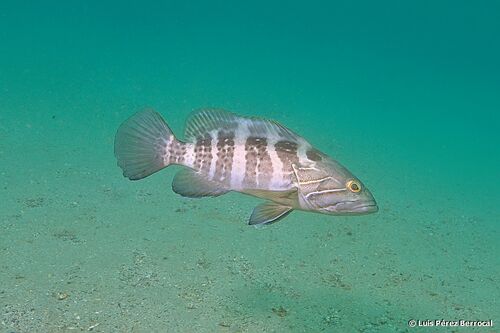
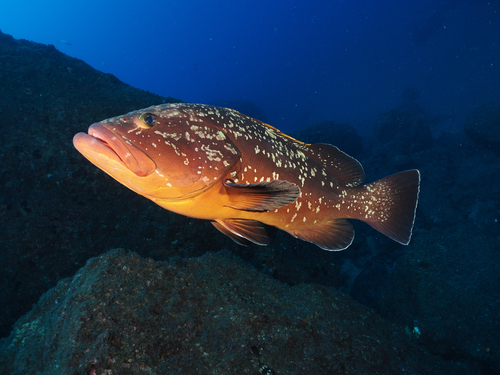
Epinephelus marginatus is a very large fish with an oval body, large head, wide mouth, and a protruding lower jaw. The head and upper body are colored dark reddish brown or greyish, and usually have yellowish gold countershading on the ventral surfaces. The base body color is marked by a vertical series of irregular pale greenish yellow, silvery grey, or whitish blotches, which are typically quite noticeable on both the body and the head. The black maxillary streak varies in how distinct it is. The median fins are dark brown; the distal edges of the anal fin, caudal fin, and often the pectoral fins have narrow white terminal bands. The pelvic fins are black toward their tips, while the pectoral fins are dark reddish-brown or grey. The margin of the spiny dorsal fin and the basal part of the pectoral fins are often golden yellow. The dorsal fin has eleven spines and 13–16 soft rays. This species can reach a maximum standard length of 150 cm (59 in), but most individuals grow to around 90 cm (35 in). Epinephelus marginatus has two separate, disjunct distribution centers. The main center is in the eastern Atlantic, ranging from the west coast of Iberia south along Africa's western coast to the Cape of Good Hope, and extends east into the southwestern Indian Ocean as far as southern Mozambique. There are doubtful records of this species from Madagascar and possibly Oman. It is also found throughout the Mediterranean Sea. The second population lives in the southwestern Atlantic off the coast of South America, in southern Brazil, Uruguay, and northern Argentina. In the eastern Atlantic, it is not normally found further north than Portugal, but rare records exist from the Bay of Biscay and the English Channel, as far north as northern France, Great Britain, and Ireland. Epinephelus marginatus is a demersal species, typically found in and around rocky reefs from surface waters down to a maximum depth of 300 metres (980 ft). It often occurs near Posidonia seagrass beds. Juveniles are generally found closer to shore than adult fish, and even occur in rock pools. In protected areas such as marine nature reserves and no-take zones, both adults and juveniles live in shallow water, but the depths where juveniles are found are always shallower than the depths preferred by adults.