About Epinephelus maculatus (Bloch, 1790)
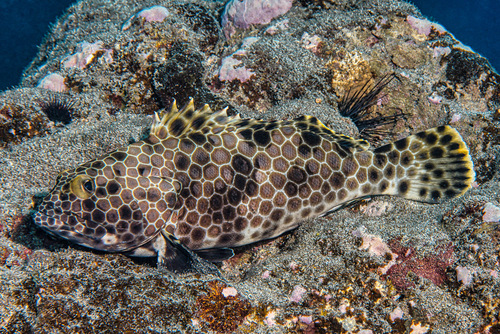
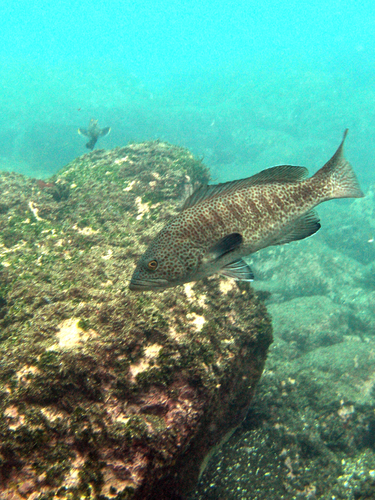
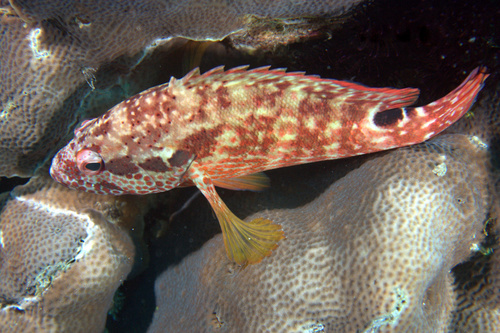
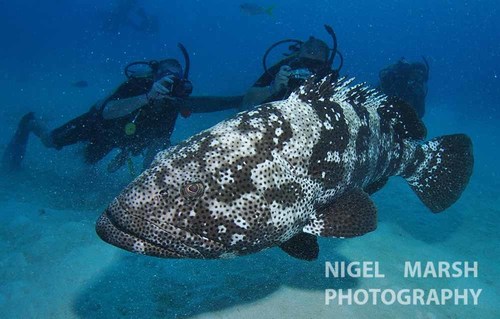
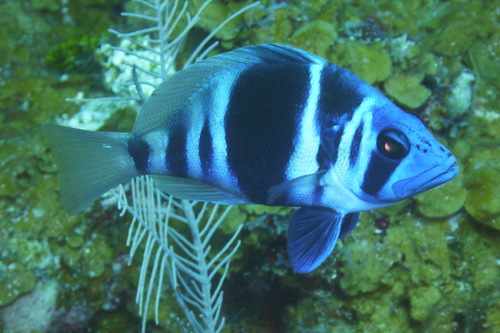
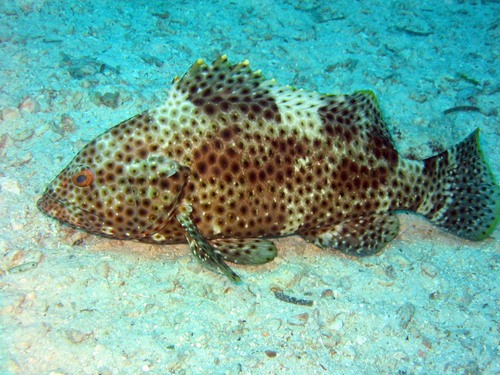
Epinephelus maculatus has a body whose standard length is 2.8 to 3.1 times its depth. The dorsal profile of the head is convex, and the area between the eyes is either flat or slightly convex. The preopercle has a notch above its angle, where enlarged serrations are located. The dorsal fin has 11 spines and 15-17 soft rays, while the anal fin has 3 spines and 8 soft rays. The dorsal fin is tallest at its anterior spiny section, and the membranes between the spines are slightly indented. The caudal fin is convex or indented in adults, and rounded in juveniles. The head and body are covered in regularly spaced brown spots; in adult individuals measuring 25 to 45 centimetres (9.8 and 17.7 in) long, these spots group into hexagonal shapes. Juveniles are initially black with white blotches, and develop their characteristic spots as they grow. This species has a maximum published total length of 60.5 centimetres (23.8 in).
Epinephelus maculatus occurs in the eastern Indian Ocean and Western Pacific Ocean. Its range extends from the Cocos (Keeling) Islands east to Micronesia and Samoa, south to Australia, and north to the Ryukyu Islands and Ogasawara Islands of Japan. In Australia, it is found around offshore reefs of Western Australia, Ashmore Reef in the Timor Sea, and Lord Howe Island in the Tasman Sea, as well as along the eastern coast from the northern Great Barrier Reef of Queensland south as far as Sydney.
Epinephelus maculatus lives on coastal and offshore coral and rocky reefs at depths from 2 to 100 metres (6.6 to 328.1 ft), and is often found over open sand near the base of these reefs. Juveniles have been recorded in shallow coral rubble. It is a predatory species that feeds mainly on small fish, crabs, and octopuses. Individuals of this species have been observed moving between reefs, making journeys of at least 5 to 10 kilometres (3.1 to 6.2 miles). Compared to other groupers, this species has a fast growth rate and a high population turnover rate. It has been recorded living up to 13 years; females reach maturity at 2.8 years old, while males reach maturity at 4 years old. They may form spawning aggregations, and are solitary otherwise.