About Epinephelus labriformis (Jenyns, 1840)
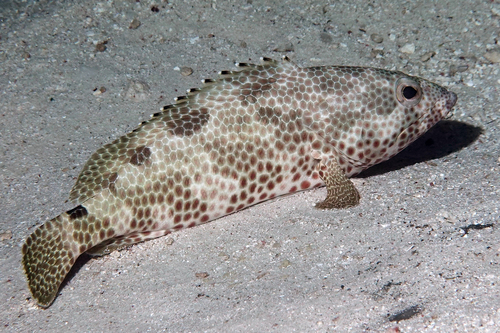
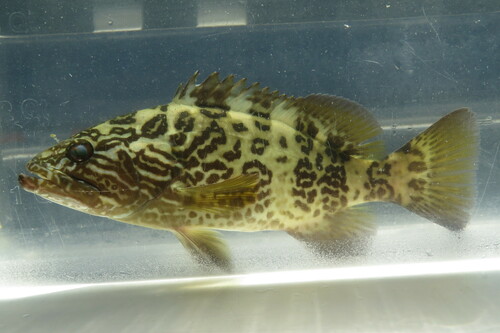
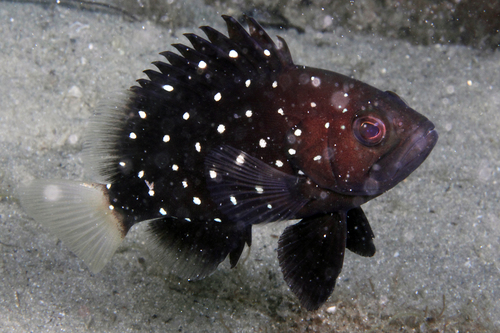
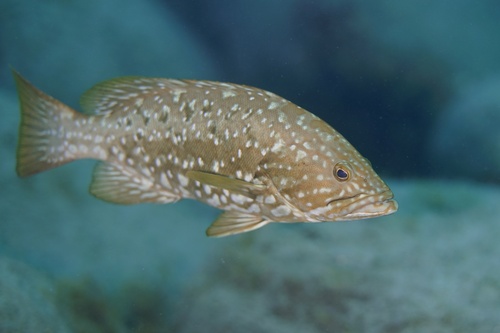
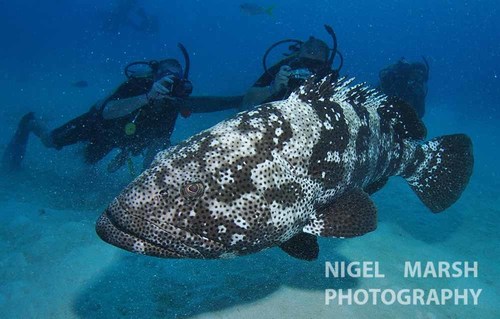
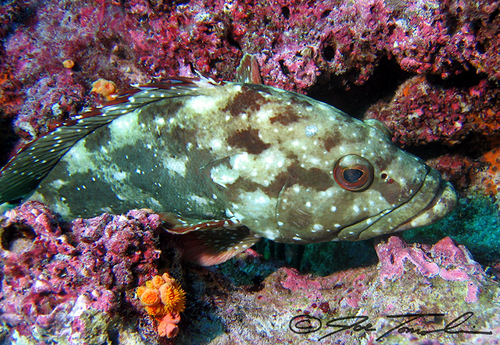
Epinephelus labriformis, commonly called the starry grouper, has a robust, compressed body, with a standard length 2.7 to 3.1 times its body depth. The intraorbital region of this species is flat. Its preopercle is rounded, finely serrated, and has slightly enlarged serrations along its lower edge. The upper edge of the gill cover is slightly convex. The dorsal fin has 11 spines and 16 to 18 soft rays, while the anal fin has 3 spines and 8 soft rays. The caudal fin is rounded. The head and body of this species are olive green, scattered with irregular white spots and blotches. Red-brown blotches appear on the head and the anterior part of the body, and there is a black saddle mark on the upper portion of the caudal peduncle. The outer margins of the dorsal and anal fins, the upper and lower margins of the caudal fin, and the outer half of the pectoral fin are red. This species reaches a maximum total length of 60 centimetres (24 in). Epinephelus labriformis is widespread across the tropical eastern Pacific Ocean, ranging from Mexico to Peru, including the offshore islands of Galápagos, Cocos Island, Malpelo, and Revillagigedo. Adult Epinephelus labriformis are most abundant in shallow water, and can also occur at depths down to 30 m. They live on rocky and coral reefs in coastal waters on the continental shelf. The starry grouper is a solitary predator that feeds on smaller fishes during the day, and feeds on crustaceans after dark. Its spawning season occurs in late summer.