About Epinephelus fuscoguttatus (Forsskål, 1775)
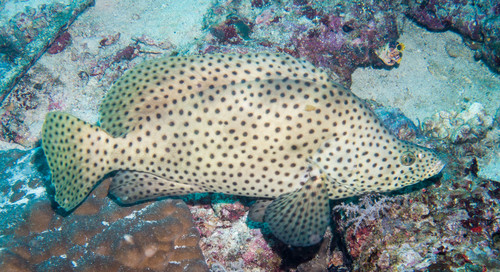
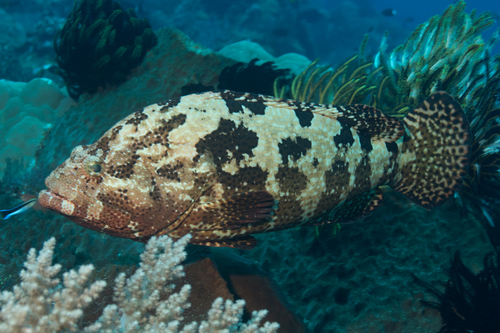
Epinephelus fuscoguttatus, commonly called the brown-marbled grouper, is a medium-sized fish. It can reach a maximum length of 120 cm, while the average size most commonly observed is 50 cm. Individuals have a stocky, robust body that is laterally compressed, with a distinct sharp head profile. The large mouth is positioned superiorly, and holds many small teeth along with canines at the front. Its base body color is pale yellowish-brown, marked with many irregularly sized and shaped dark brown or grey blotches. The entire body is also covered in numerous small, dark brown spots. All of its fins are large and round. The brown-marbled grouper can be easily confused with its close relative Epinephelus polyphekadion, and distinguishing differences are most obvious in adult specimens. Key distinctive characteristics of the brown-marbled grouper are: a small black saddle on the upper surface of the caudal peduncle, a visible notch above the eyes when viewed from the side, a clearly defined front head, and a thick body measured from the front of the dorsal fin to the underside of the fish below the pectoral fins. This species is widely distributed across tropical and subtropical Indo-Pacific waters, ranging from the eastern coasts of Africa to the central Pacific oceanic islands, and includes the Red Sea within its range. It is not found in the Persian Gulf, Hawaii, or French Polynesia. Like many other groupers, the brown-marbled grouper inhabits clear, nutrient-rich waters near coral or rocky reefs, lagoons, and external reef slopes, from the surface down to a depth of 60 metres (200 ft).