About Epinephelus daemelii (Günther, 1876)
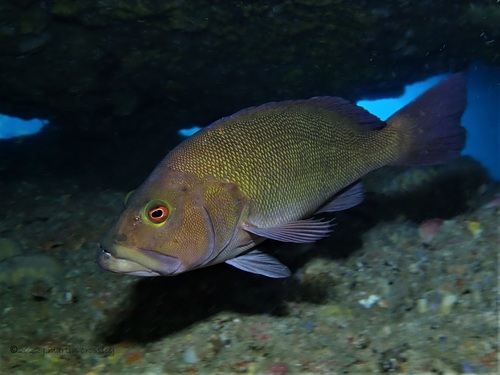
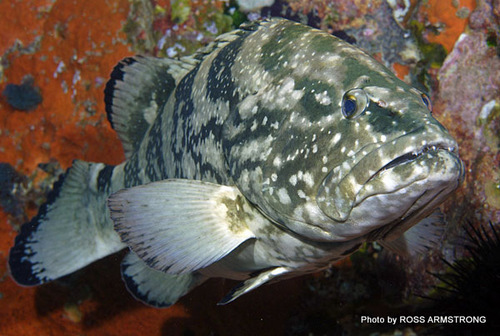
Epinephelus daemelii (Günther, 1876), commonly called the saddletail grouper, has multiple common names across different regions: it is known as black cod or black rock-cod in Australia, and as saddle-tailed grouper or spotted black grouper in New Zealand. It is a large marine fish that belongs to the family Serranidae. This species lives off the coastlines of southeastern Australia and northern New Zealand, and it generally inhabits near-shore rock and coral reefs at depths up to 50 meters. Most of the species' full range is along the southeastern coastline of Australia in the state of New South Wales. Populations in New Zealand are suspected to be nonbreeding, originating from drifting larvae from Australian populations, even though spawning aggregations have been recorded off northern New Zealand. This grouper can reach a maximum length of 200 cm and a weight of at least 68 kg. It is a generalised carnivore that preys on crustaceans and fish. It has a typical grouper body shape and appearance. Its colour can range from solid dark grey-black, but more often individuals have a blotched or banded black and white pattern. Epinephelus daemelii is a protogynous hermaphrodite: all individuals start life as females, and change sex to male once they reach an estimated length of 100 to 110 cm and an age of 29 to 30 years. Localised but drastic drops in saddletail grouper populations caused by line fishing were first observed near heavily populated areas in the early 1900s. From the 1950s through the 1970s, E. daemelii populations experienced severe decline driven by the growing popularity of spear fishing. Because of this species' large size, slow movement, curious nature, territorial behavior, and use of accessible inshore habitats, it was extremely vulnerable to spear fishing. It was heavily targeted by spear fishermen and caught in large volumes. After more than 20 years of severe decline caused by spear fishing, the New South Wales fishery department belatedly banned the spearing or taking of black cod in 1983, and later listed the species as vulnerable under New South Wales fisheries legislation. The Australian Government listed Epinephelus daemelii as vulnerable under national environmental legislation in 2012.