About Epinephelus cyanopodus (Richardson, 1846)
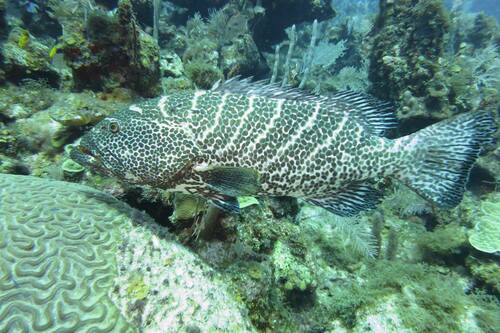
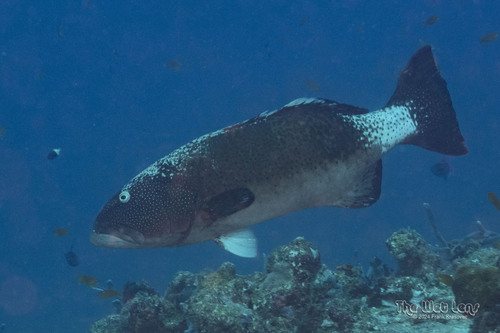
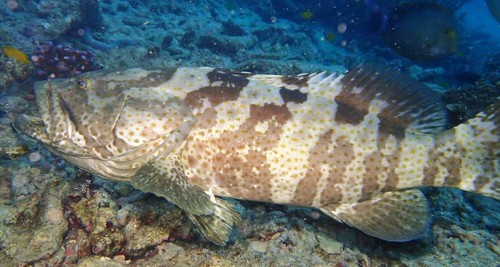
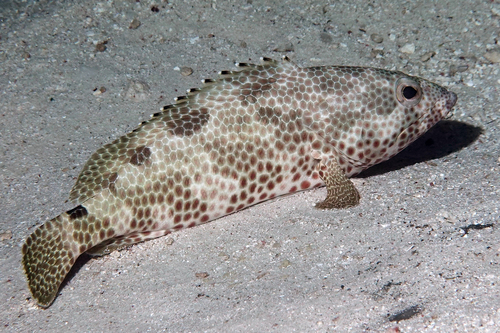
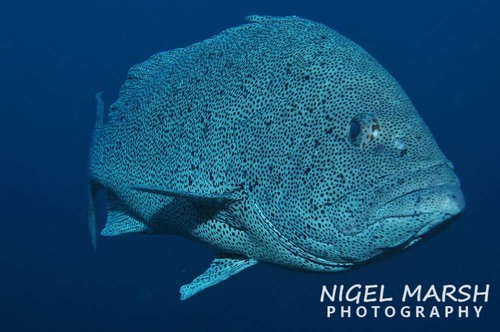
Epinephelus cyanopodus has a compressed body, with a standard length that is 2.4 to 2.7 times its body depth. It has a steep dorsal profile on the head and a noticeably convex area between the eyes. Its preopercle does not have a sharp angle, and the edge of the preopercle has fine serrations that are slightly enlarged at the angle. The gill cover has inconspicuous spines and a straight upper edge. The dorsal fin has 11 spines and 16-17 soft rays, while the anal fin has 3 spines and 8 soft rays. The membrane between the spines in the spiny section of the dorsal fin is either not incised or only slightly incised. There are 63 to 75 scales along the lateral line. Adults of this species are overall greyish, covered in small irregular dark dots, with a smaller number of larger black spots. Juveniles are yellowish, and become more greyish-blue as they mature. When juveniles reach 15–20 cm (5.9–7.9 in) in length, only their fins remain yellowish, and this yellow fin color fades as the fish ages further. This species can reach a maximum total length of 122 cm (48 in) and a maximum weight of 17.3 kg (38 lb). Epinephelus cyanopodus occurs in the Western Pacific Ocean. Its range extends from the South China Sea and the Gulf of Thailand east to the Marshall Islands and Fiji, north to southern Japan, and south to eastern Australia and the Tasman Sea. In Australia, it is found along the Great Barrier Reef, and along the coast from northern Queensland to Sydney. This grouper is most often found near isolated coral heads in lagoons or bays, though specimens have also been collected from outer reefs. It is not a cryptic species, and is normally encountered in the water column several meters above the seabed. It is frequently caught during the night. It is a predatory species that feeds mainly on fish and sand-dwelling crustaceans such as snake eels and box crabs. During the breeding season, this species forms spawning aggregations that are often mixed with other grouper species including Epinephelus polyphekadion and Epinephelus fuscoguttatus. The overall biology of this species remains poorly understood. It inhabits waters at depths ranging from 2 to 150 metres (6.6 to 492.1 ft).