About Epinephelus corallicola (Valenciennes, 1828)
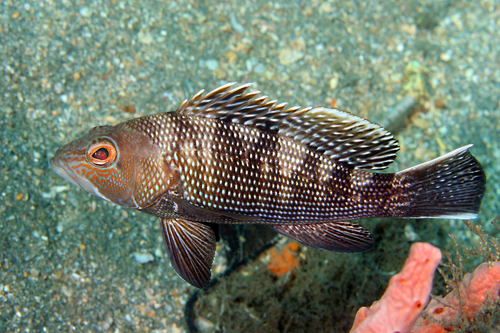
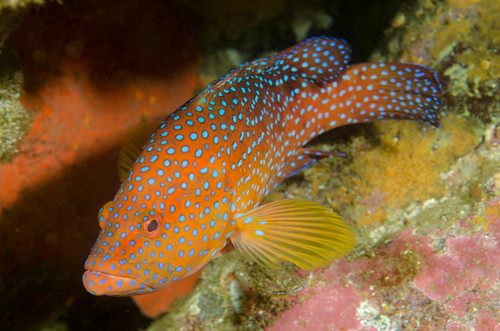
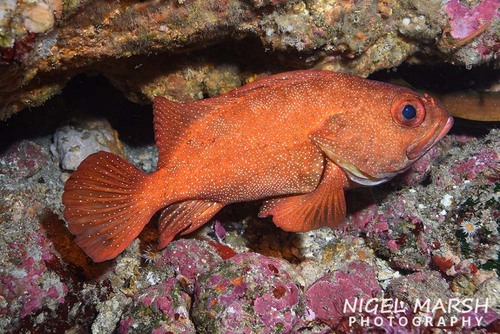
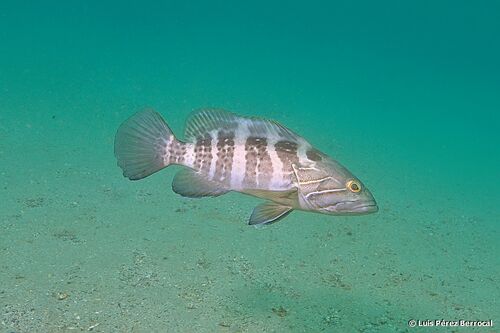
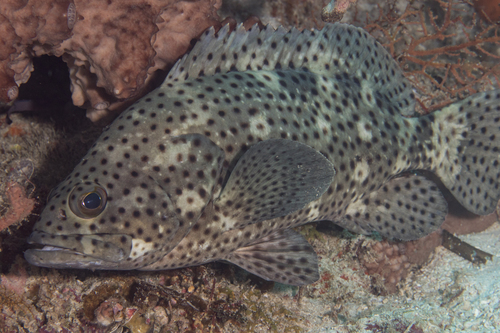
Epinephelus corallicola (Valenciennes, 1828) has a body whose standard length is 2.7 to 3.2 times its body depth. The dorsal profile of its head is almost straight, and the area between its eyes is flat. Its preopercle is rounded, with fine serrations and a slight notch. The upper edge of its gill cover has a complex structure. The dorsal fin has 11 spines and 15 to 17 soft rays, while the anal fin has 3 spines and 8 soft rays. The membranes between the dorsal fin spines are slightly notched. The caudal fin is rounded. There are 53 to 63 scales along the lateral line. This species is a light bluish-grey to greyish-green grouper, with saddle-like blotches running along its back. Dark spots are more or less evenly distributed across both its body and fins, and it also has an irregular pattern of paler blotches. The maximum published total length for this species is 49 centimetres (19 in). This species is distributed in the eastern Indo-Pacific region. Its range extends from Thailand eastwards through Indonesia and the Philippines to Australia, Micronesia and Palau, and it is rarely recorded off northern New Caledonia. In Australia, it occurs from Ningaloo Reef in Western Australia, along the continent’s tropical northern coasts, to northern New South Wales. Epinephelus corallicola can be found in a range of habitats, from silty shallow reefs to clear waters on outer reef slopes, at depths between 1 and 30 metres (3.3 and 98.4 ft). It is sometimes also found in estuaries. As of yet, there has been little research conducted on the biology of this species.