About Epinephelus coioides (Hamilton, 1822)
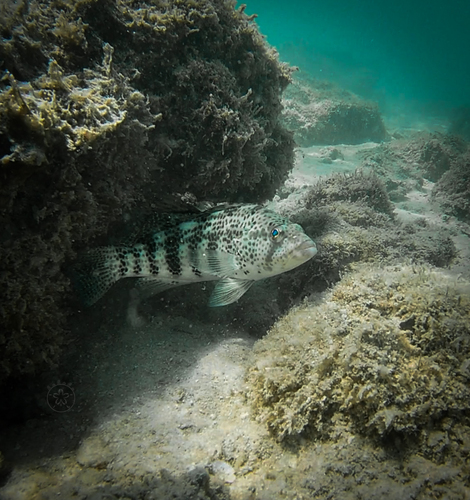
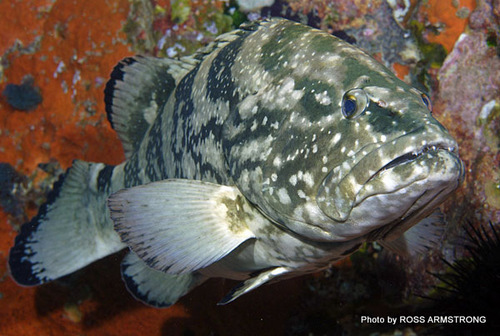
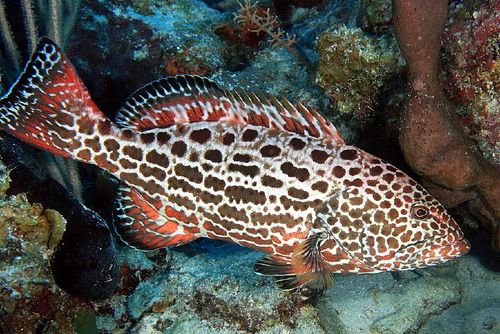
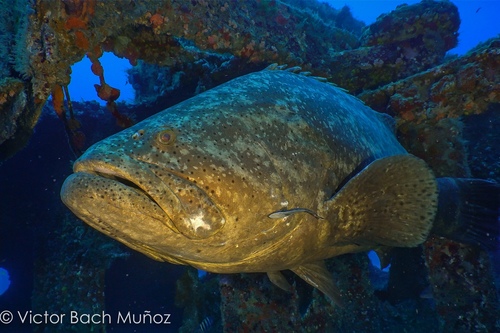
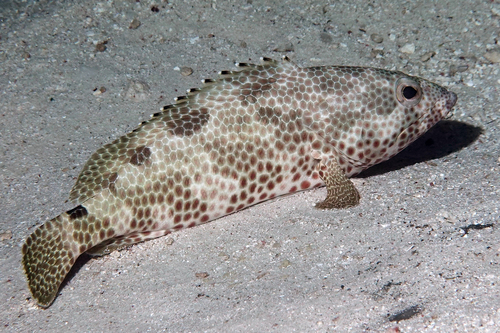
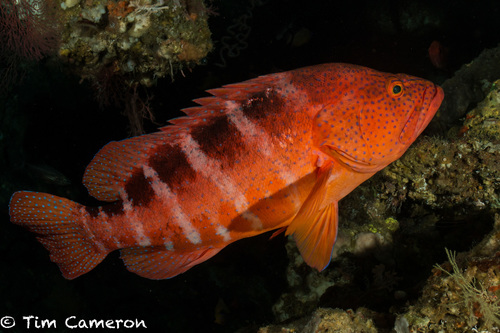
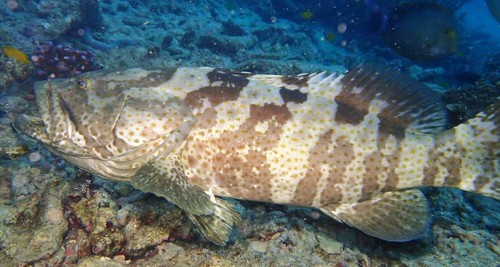
The orange-spotted grouper, Epinephelus coioides, has an elongated body with a standard length 2.9 to 3.7 times its body depth. The dorsal profile of the head is flat or slightly convex between the eyes. The preopercle has enlarged serrations at its angle, with a shallow notch just above the angle. The upper margin of the gill cover may be straight or slightly convex. The dorsal fin has 11 spines and 13 to 16 soft rays, while the anal fin has 3 spines and 8 soft rays. The membranes between the dorsal fin spines are clearly incised. The caudal fin is rounded, and there are 58 to 65 scales along the lateral line. The head and upper body are light brown, fading to whitish on the underparts. There are four oblique H-shaped dark markings on the flanks, 3 to 4 dark saddle-like blotches along the back, and numerous small brown or orange spots covering the head, body, and all fins. In juvenile fish, the spots are larger and fewer in number; spots shrink in size and increase in number as the fish grows. The maximum published total length for this species is 120 centimetres (47 in), and the maximum recorded weight is 15 kilograms (33 lb).
Orange-spotted groupers have an Indo-Pacific distribution. They are found along the eastern coast of Africa, from the Gulf of Suez south to Durban in South Africa. They also occur off Madagascar, Mauritius, and Réunion, and from the Persian Gulf eastward into the Pacific Ocean as far as Palau and Fiji. Their range extends north to Japan and south to Australia. In Australia, the species is found from Carnarvon, Western Australia along the tropical northern coasts to the Solitary Islands in New South Wales. It was first observed in the Mediterranean Sea off Israel in 1969, and has been recorded rarely there since. This species has been tested for mariculture in multiple countries, and mariculture is a possible vector for its introduction to new areas.
This grouper lives in coral reefs, especially those along mainland coasts and large islands. Juveniles are frequently found in estuaries with sand, mud, and gravel substrates, and in mangroves. It is a predatory species that feeds on fishes, shrimp, crabs, and other benthic crustaceans. At night, these fish will bury themselves at least partially in mud. Orange-spotted groupers are diandric protogynous hermaphrodites: some males develop directly from juveniles, while others develop from functional females when the fish reach around 67 centimetres (26 in) in length and 7.5 years of age. Off Papua New Guinea, they have been reported to gather to spawn in aggregations of around 1,500 individuals, with spawning occurring for 3 to 4 days each month over muddy and sandy substrates. In the Persian Gulf, the spawning season runs from March to June. The species' eggs and larvae are thought to be pelagic.