About Epinephelus coeruleopunctatus (Bloch, 1790)
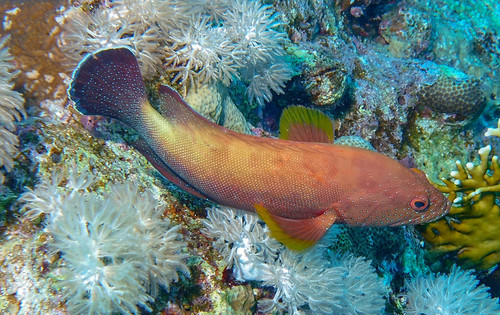
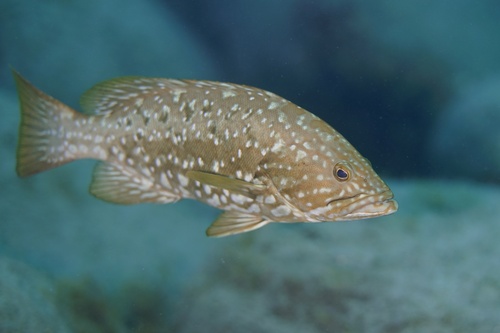
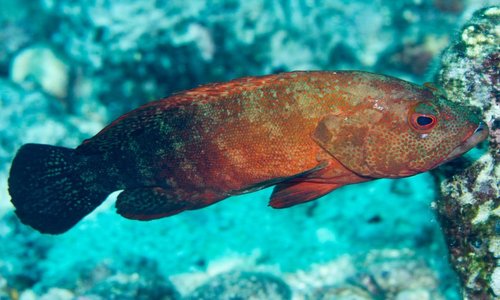
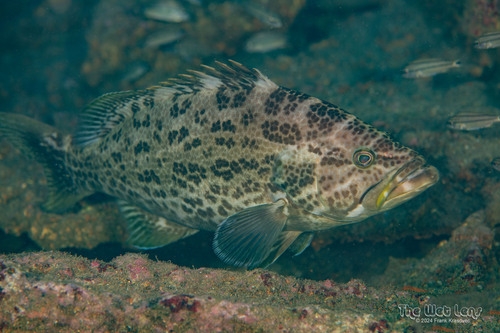
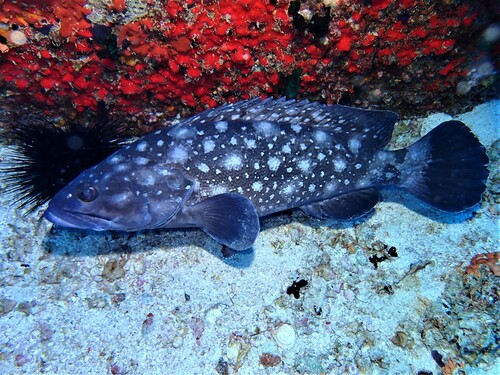
Epinephelus coeruleopunctatus, commonly called the whitespotted grouper, is a moderately deep-bodied fish that reaches a maximum length of around 76 cm (30 in). This species has three to five rows of teeth in its lower jaw. Its dorsal fin has eleven spines and approximately sixteen soft rays, while its anal fin has three spines and eight soft rays. The pelvic fins are short, and the caudal fin is rounded. The top edge of the opercular cover is only slightly convex, and its posterior edge curves at an acute angle. The head, body, and dorsal fin are dark brownish-grey, marked with large white blotched spots. In large adults longer than about 30 cm (12 in), these white patches tend to merge into wavy bands or mottled patterning. The whitespotted grouper occurs in shallow waters across the Indo-Pacific region. Its distribution range extends from the coast of East Africa and the Persian Gulf eastward to Japan, China, Indonesia, Australia, Fiji, and Tonga. This is a demersal, shallow-water, reef-associated fish. It is most commonly found in rocky areas, near coral growth in deep lagoons, on outer reef slopes, or in reef channels, often located close to or inside caves. It is not a schooling species and is typically found alone. It feeds on small fish and crustaceans, with crustaceans forming the largest portion of its diet. Very little is currently known about this species' reproduction and life history.