About Epilobium brunnescens (Cockayne) P.H.Raven & Engelhorn
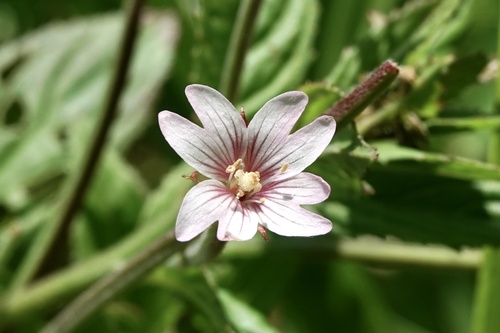
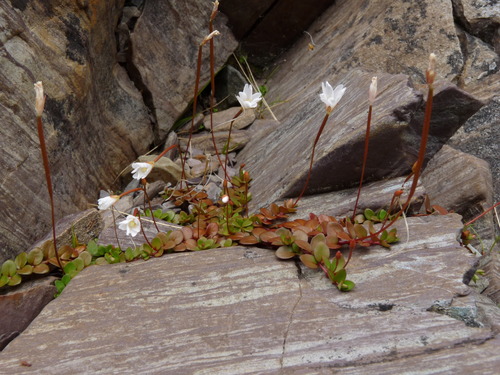
Epilobium brunnescens (Cockayne) P.H.Raven & Engelhorn is a low-growing, mat-forming plant with trailing stems that grow up to 20 centimetres (8 in) long. Its stems have two rows of tiny hairs and produce roots at the nodes. The leaves are rounded, typically 3–7 millimetres long (sometimes reaching 10 millimetres), purplish on the lower surface, have smooth or slightly toothed edges, and are attached by a 0.5–3 millimetre stalk. Flowers have white or pale pink petals that measure 2.5–4 millimetres in length. This species is widespread across New Zealand, where it occurs in the North Island, South Island, Stewart Island, the Auckland Islands, and the Campbell Islands; it is also found on Macquarie Island, an Australian possession. It grows in a range of habitats, most commonly open, shingly riverbeds in high rainfall regions. Two subspecies of Epilobium brunnescens occur in New Zealand: E. b. subsp. brunnescens, which usually has nodding flowers, and E. b. subsp. minutiflorum, which usually has erect flowers. The subspecies E. b. subsp. beaugleholei is restricted to a single site in Alpine National Park, eastern Victoria, south-eastern Australia, where it grows on wet, mossy rocks near a waterfall at an altitude of around 1,320 metres (4,330 ft). A 2001 survey found only three patches of this subspecies, covering a total area of 1 m² (11 sq ft). E. b. subsp. beaugleholei is considered to be at high risk of extinction, with threats including rock fall, drought, illegal collection, and damage by visitors. Epilobium brunnescens subsp. brunnescens has been introduced to Great Britain and Ireland. It was first recorded in 1904 in Craigmillar, Edinburgh, spread rapidly from the 1930s onward, and is now widespread in northern and western areas with higher rainfall and humidity. It has not yet spread to many parts of southern and central England, and central Ireland. In this introduced range, it grows in a variety of damp, open, gravelly or stony habitats including hillsides, stream banks, waste tips, stone walls, paths, and railway sidings. The species has also been introduced to Norway, where it was first recorded in 1931 and remains rare.