About Epifagus virginiana (L.) Barton
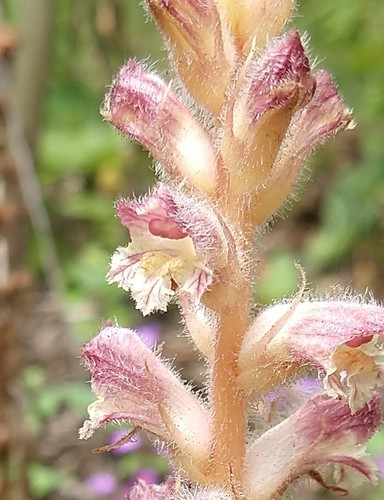
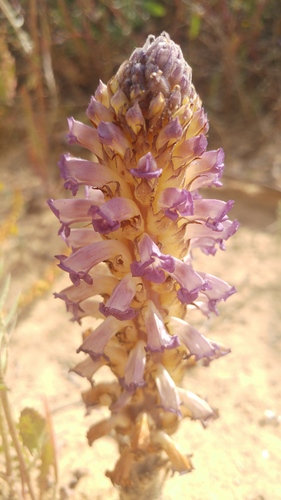
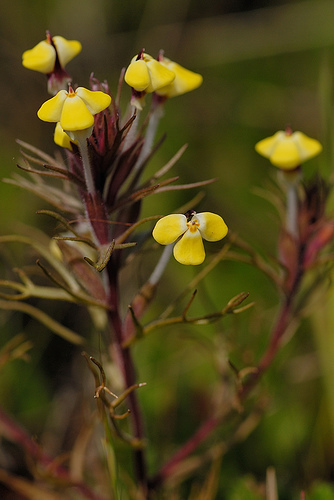
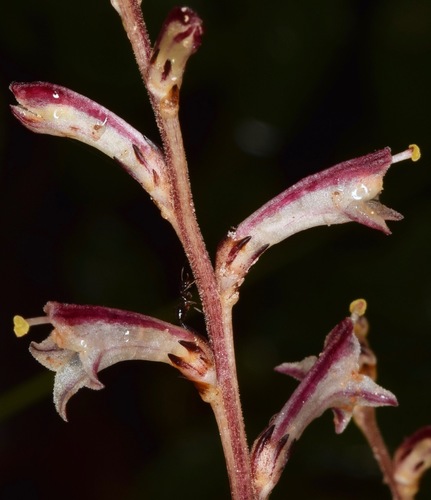
Epifagus virginiana, commonly called beechdrops, is a parasitic plant native to eastern North America. It has no chlorophyll at all, and grows many brown stems that reach up to 30 cm in height. Small white and purple flowers grow on these stems, blooming from July through October. The flowers have tubular, zygomorphic corollas around 8 mm long, with one single style and four stamens inside. Dried flower stalks remain on the plant throughout the winter. Lower on the plant, flowers are cleistogamous, meaning they self-pollinate, while flowers at the top of stems are chasmogamous, cross-pollinating, and may be sterile. Beechdrops has very small, alternate, scale-like leaves that are a vestigial structure left over from a photosynthetic ancestor. Epifagus virginiana germinates in response to a chemical signal released by the roots of beech trees. In its early development stages, beechdrops does not rely on its host, instead using nutrients stored in its seed. It can take several years before an above-ground structure develops. These early underground stages of E. virginiana are only a few millimeters in size and are butter yellow. Next, beechdrops grows a haustorium that penetrates the host’s roots. When the plant reaches maturity, the haustorium degrades and a tuber forms. E. virginiana flowers in late summer and early fall, producing the same two flower types: chasmogamous flowers at the top of the plant that are cross-pollinated and sometimes sterile, and self-fertile cleistogamous flowers that grow at the base of the plant. Seeds of E. virginiana are small and dispersed by rainwater. Between dispersal and germination, the seeds undergo cellular changes: the embryo changes color and its cells develop new granules. The main host habitat of Epifagus virginiana is temperate forests in northeastern North America, including the U.S. Midwest and Canada. Significant populations of beechdrops grow in Indiana, Ohio, and Michigan, and the species has been documented along the East Coast from Maine to South Carolina. E. virginiana is pollinated by Prenolepis imparis, commonly known as the winter ant. This insect pollination is required for pollination of the chasmogamous flowers, so E. virginiana depends on ant pollination to produce both cross-pollinated and self-fertilized seeds. Ants are not thought to pollinate the self-fertile cleistogamous flowers. Because beechdrops depends entirely on its host beech tree and is sensitive to environmental conditions, it is used to monitor forest health. Beech trees (Fagus grandifolia) can spread into a new forest area faster than E. virginiana can, so the presence of F. grandifolia is used to predict when E. virginiana will colonize an area. E. virginiana itself is not a threat to the health of host beech trees, but an absence of beechdrops in an area where beech trees grow is an indicator of declining forest health.