About Epidendrum cinnabarinum Salzm. ex Lindl.
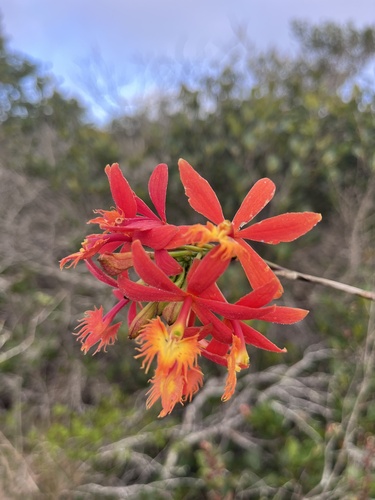
Epidendrum cinnabarinum Salzm. ex Lindl. is a sympodial reed-stemmed Epidendrum with a pseudomonopodial growth habit. A single individual stem grows up to 1 meter tall, growing continuously at the tip for some time and bearing fleshy lanceolate green leaves that measure 2 cm wide by 10 cm long, before producing a terminal bloom spike. This bloom spike usually equals or exceeds the length of the stem. Flowers grow from the top of the stem, which halts the stem’s upward growth, and new stems emerge from buds at the base of older stems. This growth pattern makes the plant sympodial, consistent with other members of the subtribe Laeliinae. The inflorescence is a short, highly congested raceme of non-resupinate ruby red to orange flowers. It sits at the end of a long peduncle covered from its base through much of its length with tight overlapping sheathes. The deeply lacerate trilobate lip is adnate to the end of the column. It has an orange region surrounding the end of the column, a pair of tubercles on either side of the column, and a keel or carina between the tubercles. Unlike some crucifix orchids, E. cinnabarinum cannot tolerate temperatures below 2 °C. The diploid chromosome number of E. cinnabarinum is 2n = ~240, and the haploid chromosome number ranges from 108 to 124. In the wild, E. cinnabarinum grows in Brazilian coastal states, ranging from Rio Grande do Norte in the north to Bahia in the south. It is also found growing in Venezuela.