About Epidares nolimetangere (de Haan, 1842)
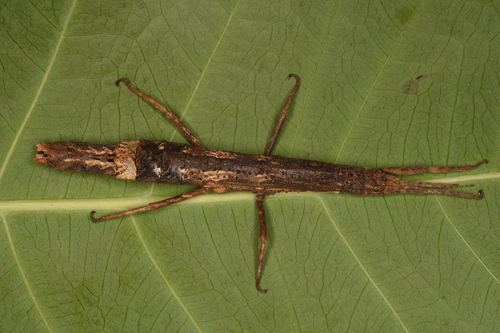
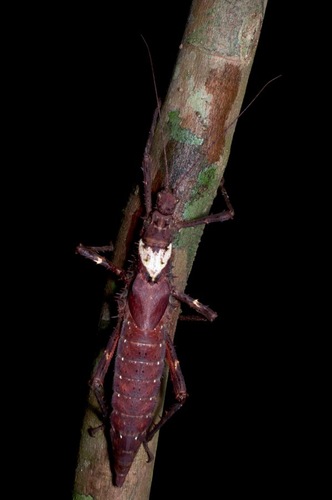
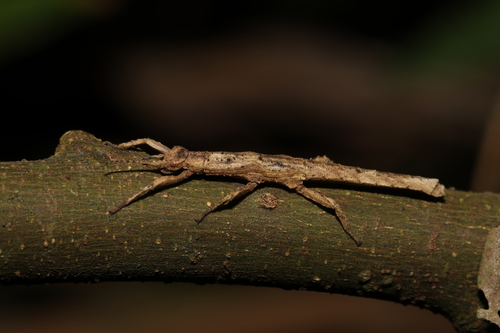
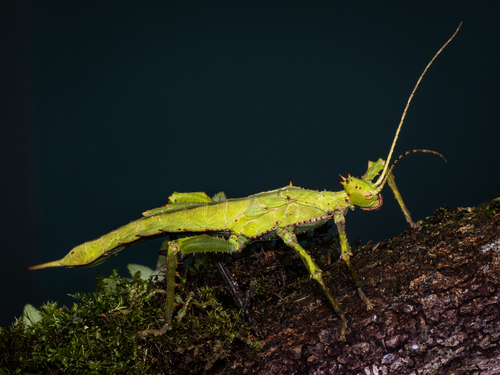
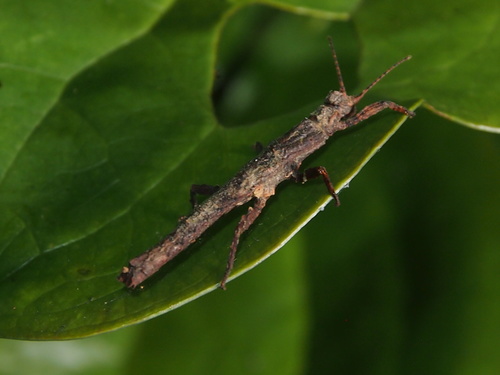
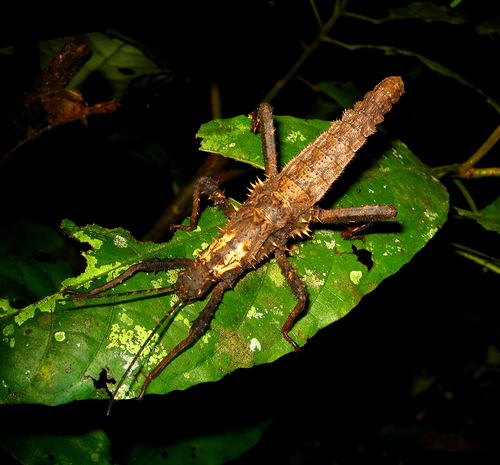
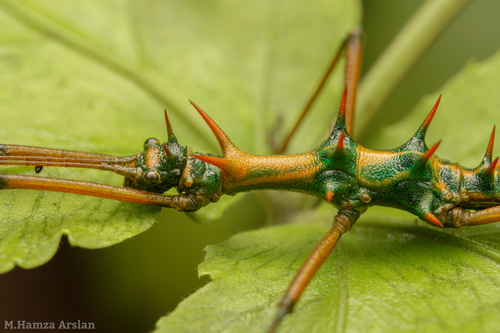
Epidares nolimetangere is one of the smaller species in the order Phasmatodea. Adult males range from 35 to 43 mm in length, while adult females reach 45 to 48 mm in length and have shorter spines than males. Both sexes are wingless. The species has a pair of spines on the head, a pair of spines on the anterior margin of the mesonotum, and a ring of four spines on the posterior margin of both the mesothorax and metathorax. Males only have one additional pair of spines across their entire abdomen, located on the second abdominal segment. Females have this pair on the second segment plus an extra pair on the third abdominal segment, which is also complemented by smaller, mostly lateral spines. Females are solid dark brown apart from a light central stripe, and the abdomen of egg-laying females is thickened in the middle. Males have dark areas on the dorsal side starting from the posterior mesothorax, particularly around the spines and across the abdomen. Additional dark spots are present on the pronotum and between the lateral and dorsal spines of the meso- and metathorax, while the spines themselves are light-colored. On the abdomen, the dark areas merge to form two parallel longitudinal stripes. These spots can be small, significantly larger, or flow together, and their color ranges from brown to dark green or metallic green. The male base color varies from light brown on the legs to bright red that is most prominent on the head, thorax, and the top of the abdomen, depending on the location the specimens were collected from. Other location variants are simply light brown between the green spots. Sources recognize two common color forms: a red form with a more red base color and smaller spots, and a green form with larger, more metallic green spots. Ian Abercrombie discovered another clearly distinct color form, in which males are golden. Francis Seow-Choen also refers to the color form found in Bako as golden, and describes a second color form from the area around Kuching as dark or blue. Epidares nolimetangere is native to Borneo, where it is very common in the northwest, specifically in the Malay state of Sarawak. In this region, it reaches the highest observed population density of any stick insect species living on Borneo. The insects inhabit low shrub vegetation in tropical rainforests. Known food plants include Rosaceae such as Rubus moluccanus (Molucca bramble), Melastomataceae such as Clidemia hirta, Vitaceae such as Leea indica, Acanthaceae such as Strobilanthes alternata, and Bonnetiaceae such as Ploiarium alternifolium. Females lay one to three eggs per week over a period that can last up to twenty months. Individual eggs are 3.5 to 3.9 mm long, 2.9 to 3.1 mm wide, and weigh an average of 6.8 mg. Eggs are covered with barbed hairs. Females deposit each egg individually into a hollow dug with their legs. To place the egg, the female bends her abdomen forward over her back, and the released egg rolls over her parallel-held antennae into the hollow, which is then covered back over after egg laying. Nymphs that are 7 to 12 mm long hatch from the eggs after three to six months. Males reach adulthood after approximately eight months, while females reach adulthood after approximately ten months. Females begin laying eggs three to four weeks after reaching adulthood.