About Epicrates maurus Gray, 1849
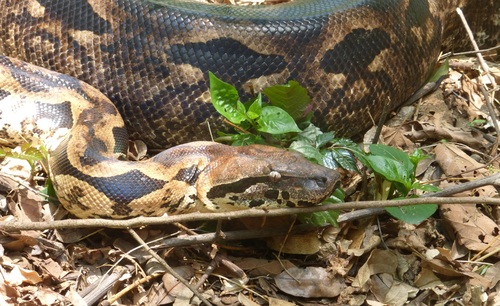
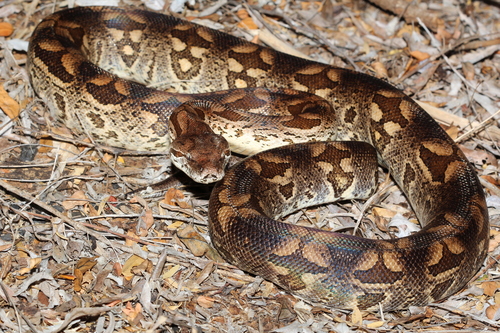
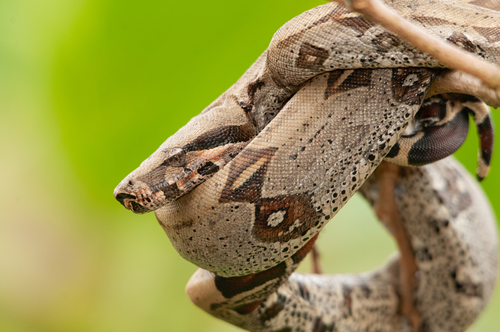
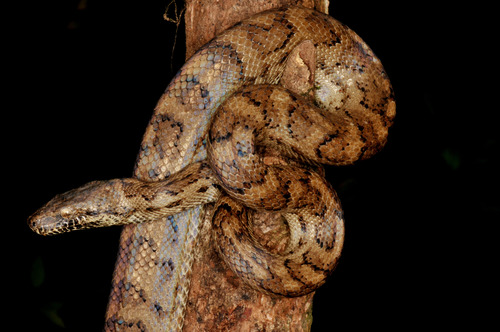
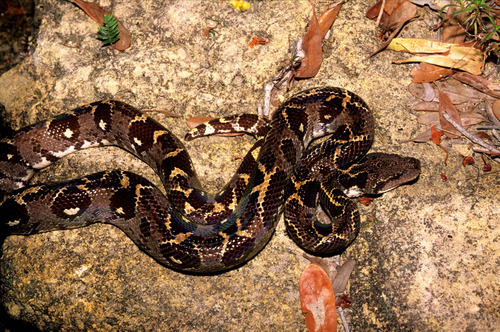
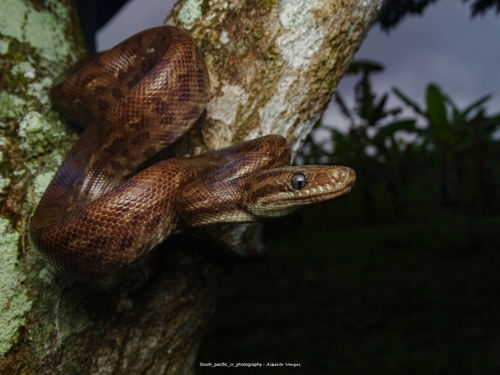
Epicrates maurus, commonly called the brown rainbow boa, is the smallest species of rainbow boa. On average, individuals reach 3 to 5 feet in length, though average length varies by subspecies. The most common subspecies kept in captivity is the Colombian rainbow boa, Epicrates maurus colombianus, which grows 5 to 6 feet long and reaches maturity between 4 and 6 years old. This species shows clear sexual dimorphism: females are significantly larger than males in both length and girth. In terms of coloring, Epicrates maurus is generally uniform brown, with large dark-edged vertebral rings that have light centers forming saddle-shaped markings. A slightly off-center 'S' pattern may also be present. Through a process called metachrosis, these rainbow boas undergo a day-to-night color change. The most visible change is that their pattern becomes lighter, almost silver, and their sides and underside turn to a mottled silver. Rare individuals with abnormal colors or patterns caused by pigmentation disorders such as albinism do exist; these are very uncommon in the wild, and are most often found in captivity where these color mutations are selectively bred. Epicrates maurus is the northernmost ranging species of rainbow boa. Its distribution covers southern Central America, Trinidad and Tobago, and northern South America, where it inhabits both rainforests and drier coastal clearings. Young Colombian rainbow boas are semi-arboreal, climbing into trees and shrubs to forage and avoid terrestrial predators, but they become mostly terrestrial as they age. Colombian rainbow boas are solitary, only coming together to mate. The species is polygynous and ovoviviparous: males may mate with multiple females, and females give birth to live young. Females invest a large amount of maternal energy into their offspring, as the young develop inside the mother's body. This developing environment is thermoregulated and protected, and provides nutrients directly to the growing young. Offspring are born fully developed, and become independent within minutes of birth.