About Epibulus insidiator (Pallas, 1770)
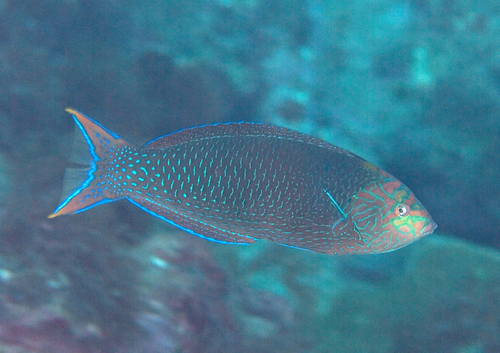
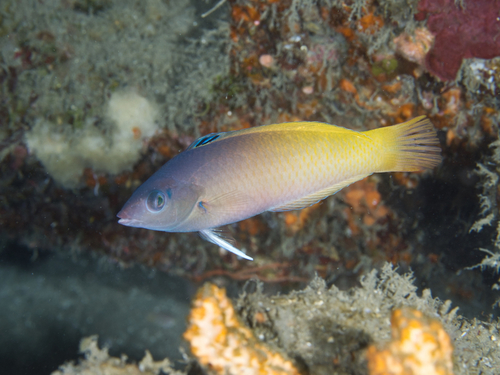
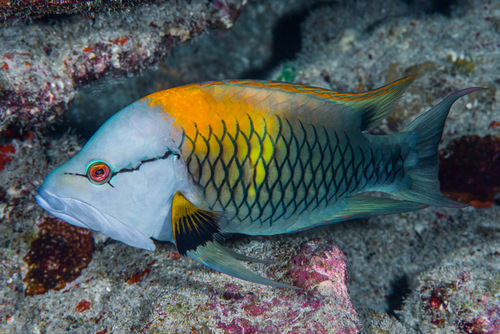
Juvenile Epibulus insidiator are brown, with thin white bars on their flanks and white lines radiating out from their eyes. Females of this species can be either bright yellow or dark brown. The yellow female morph may be an example of mimicry, matching the coloration of several damselfish species. Males are greyish-brown with orange coloring on the back, a yellowish transverse bar on the flank, and a pale grey to white head marked by a thin black stripe running through the eye. The scales on a male's body are edged with darker pigment. Intermediately patterned individuals do occur, with yellow blotches, a pale tail, and sometimes black pectoral fins. This species' dorsal fin has 9–10 spines and 9–11 soft rays, while the anal fin has 3 spines and 8–9 soft rays. The largest known specimens can reach a standard length of 54 centimetres, or 21 inches. The closely related latent sling-jaw wrasse (Epibulus brevis) has a more restricted distribution, grows to a smaller maximum size, and has different coloration, with duller coloring in males. Female E. brevis have black pigment on their pectoral fins, longer pectoral fins, and lack the black lines radiating from the eyes that are seen in juvenile E. insidiator.
The slingjaw wrasse (Epibulus insidiator) has a wide distribution across the Indo-Pacific region. Its range extends from the eastern coast of Africa, including Madagascar and the Red Sea, east through the Indian Ocean coastline and islands into the Pacific Ocean, reaching as far east as Johnston Atoll near Hawaii. Vagrants of this species sometimes occur in the main Hawaiian island chain. The species reaches north to Japan and south to New Caledonia. It is also found along the northern coasts of Australia, from the Houtman Abrolhos archipelago to reefs of the Coral Sea off Queensland.
This species is likely protogynous hermaphrodite: individuals first mature as females, and later transition to male. Males hold territories of 500–1,000 square metres (5,400–10,800 square feet), and multiple females typically have their home ranges within a male's territory. During courtship, males are observed to develop more intense body coloration. They also swim with their caudal fin collapsed and held upwards at an angle, while their anal fin is folded and stretched downwards. A male's color intensity can return to normal when they feel threatened. Spawning occurs around high tide. When spawning, the spawning pair ascends 2–3 metres (6.6–9.8 ft) into the water column. Spawning appears to be initiated by females, and has been recorded in March, April, May, July, September and October.