About Epibulus brevis Carlson, Randall & Dawson, 2008
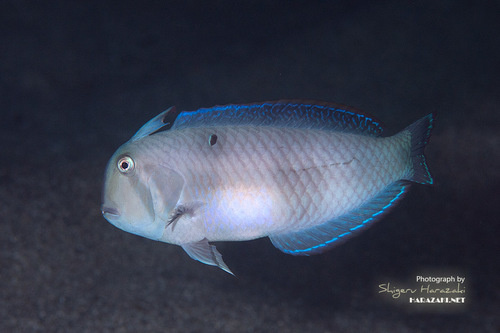
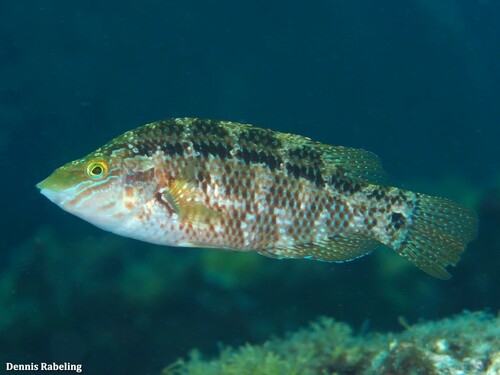
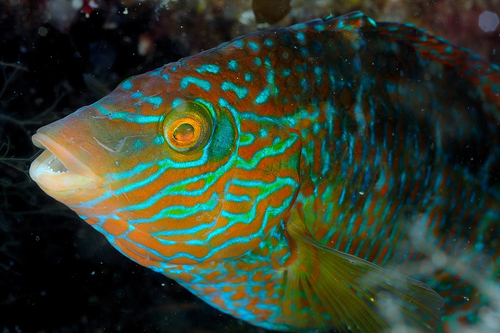
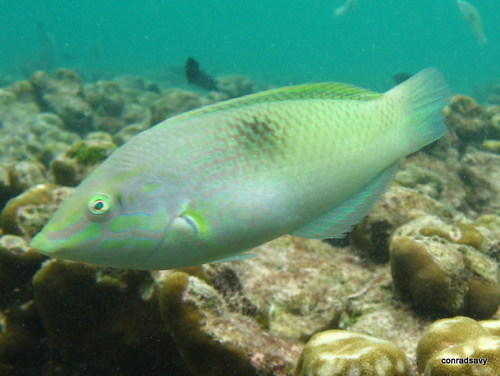
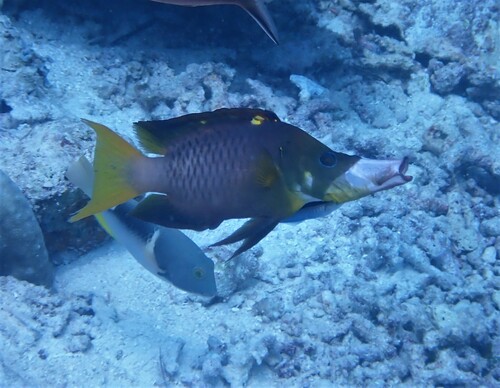
Commonly known as the latent sling-jaw wrasse, Epibulus brevis is a species of wrasse formally described in 2008 by Bruce A. Carlson, John Ernest Randall & Michael N. Dawson, with its type locality at Ngerikuul (Nikko Bay), off the south shore of Bukrrairong Island in Koror, Palau. Its specific epithet brevis is Latin for "short", referring to this species' smaller size compared to its only congener, the sling-jaw wrasse Epibulus insidiator. The latent sling-jaw wrasse is similar to E. insidiator, but can be easily distinguished by several traits: it has no black "streaks" around the eyes, males have comparatively duller colouration, most females have black areas on the fins, it has slightly longer pectoral fins, and it reaches a smaller maximum size. Male latent sling-jaw wrasses are brown with a yellow throat, yellowish tail lobes, and a yellow marking at the gill slit. Females show more variable colouration, ranging from dark to pale brown, yellow, or almost white, and most have black markings on their pectoral fins. Juveniles are brown to greenish-brown, and have black spots on their dorsal and anal fins. This species has 9 spines and 10 soft rays in its dorsal fin, and 3 spines and 8 soft rays in its anal fin. Like its congener, it has long jaws whose rearmost section extends almost to the base of the pelvic fins; this anatomy lets the fish significantly protrude its jaws, which is the origin of its common name. The latent sling-jaw wrasse is distributed in the western Pacific, and has been recorded from Palau; Luzon and Cebu Province in the Philippines; Bali, Lombok, Sulawesi, and Flores in Indonesia; Milne Bay Province and Madang Province in eastern Papua New Guinea; the Solomon Islands; and Hibernia Reef, a territory of Ashmore and Cartier Islands in the Timor Sea, northwest of Western Australia. It inhabits sheltered inshore reef waters, lagoons, and nearby seagrass beds. This species is a protogynous hermaphrodite, and has been recorded spawning in late afternoons with no correlation to tide state. Males have less obvious displays than those of the sling-jaw wrasse: they usually display just above the substrate (though they may display higher in the water column) by swimming conspicuously around their territory to attract females. During courtship, the male folds his caudal fin, holds his dorsal and anal fins close to his body while swimming around prospective females, and maintains an overall understated display. When spawning, the fish perform a varied rush that can take the form of a low arch or a brief, rather leisurely upward movement, during which the male spreads his median fins away from his body. The latent sling-jaw wrasse is a carnivore that feeds on crabs, other crustaceans, and smaller fishes. Adults are solitary when not breeding. Juveniles are very secretive, and hide in crevices or among branching corals.