About Ephippiorhynchus senegalensis (Shaw, 1800)
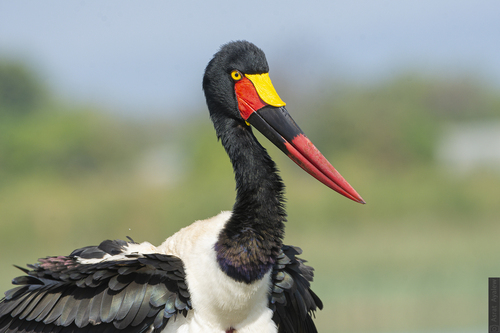
This species, the saddle-billed stork, has the scientific name Ephippiorhynchus senegalensis (Shaw, 1800). The saddle-billed stork is a very large bird. It typically reaches a height of 145 to 150 cm (4 ft 9 in to 4 ft 11 in), a length of 142 cm (4 ft 8 in), and a wingspan of 2.4 to 2.7 m (7 ft 10 in to 8 ft 10 in). While most recorded heights fall within this narrow range, adult saddle-billed storks held in captivity have been reported to reach heights between 150 and 180 cm (4 ft 11 in to 5 ft 11 in). Males are larger and heavier than females. Male body mass ranges from 5.1 to 7.52 kg (11.2–16.6 lb), with an average mass of 6.38 kg (14.1 lb). Female body mass usually ranges between 5 and 6.84 kg (11.0 and 15.1 lb), with an average mass of 5.95 kg (13.1 lb). Among large stork species, the saddle-billed stork overlaps broadly in body size with the two larger Leptoptilos species and the Jabiru stork. However, it has a longer, more slender neck and slightly longer legs than these other very large storks, which makes it likely the tallest living stork species in the world. Its extremely long legs have a tarsus length that reaches up to 36.5 cm (14.4 in). Its long bill measures between 27.3 to 36 cm (10.7 to 14.2 in). The sexes can be easily told apart: females have golden yellow irises, while males have brown irises and dangling yellow wattles. This makes the saddle-billed stork one of the few stork species that shows sexual dimorphism in coloration. The species has striking plumage. Males and females look identical when perched, but females show much more white on their primary feathers when in flight. The head, neck, back, wings, and tail are iridescent black, while the rest of the body and the primary flight feathers are white. Juvenile saddle-billed storks have browner grey plumage. The massive bill is red, marked with a black band and a yellow frontal shield that gives the species its common name (the "saddle"). The legs and feet are black, with pink hocks. A bare red patch of skin is present on the chest, and this patch darkens in color during the breeding season. Across its continental range, the saddle-billed stork prefers protected areas that have more open water than areas occupied by other stork species. However, this observed preference may be affected by observation bias, as ornithologists more frequently study safer, accessible areas like national parks and protected swamps. For feeding, the saddle-billed stork searches for prey by stabbing its bill into water, mud, and vegetation, catching prey by contact. It also hunts through visual detection of prey. In one study totaling 255 minutes of observation, 71% of successful prey captures came from visual foraging, while 29% came from tactile foraging. It usually feeds on aquatic prey including fish such as lungfish (Protopterus spp.) and catfish (Clarias spp.), and can take prey up to 1.3 kg (2.9 lb) in weight. It swallows fish head first, then drinks water after eating. When catching large fish, the stork often brings the fish to shore, may clip off the fish’s pectoral fins, then swallows it head first. The saddle-billed stork also opportunistically catches other prey, including frogs, snails, small mammals, birds, snakes, and insects such as grasshoppers, termites, and water beetles. There is a recorded unusual case of a saddle-billed stork killing and eating a red-billed duck (Anas erythrorhyncha) and a Mozambique spitting cobra (Naja mossambica). An unsuccessful attack on a slender mongoose (Galerella sanguinea) has also been reported.