About Ephippiorhynchus asiaticus (Latham, 1790)
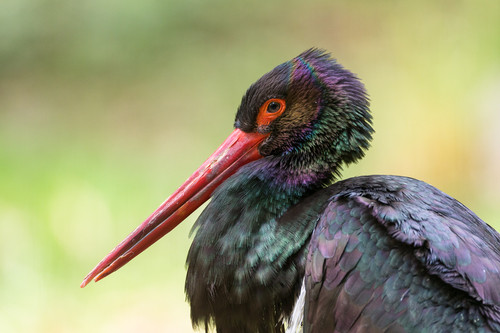
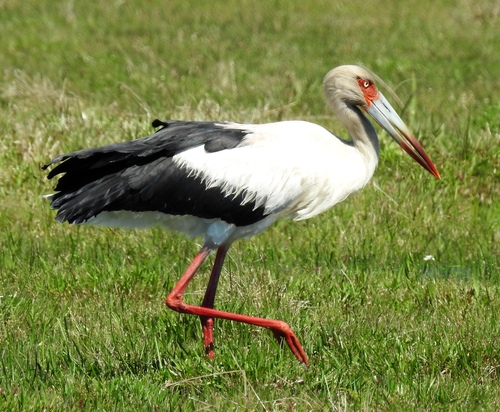
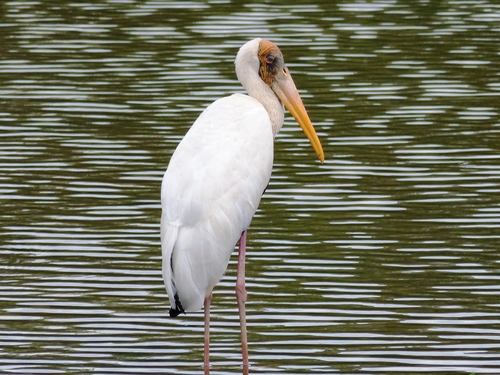
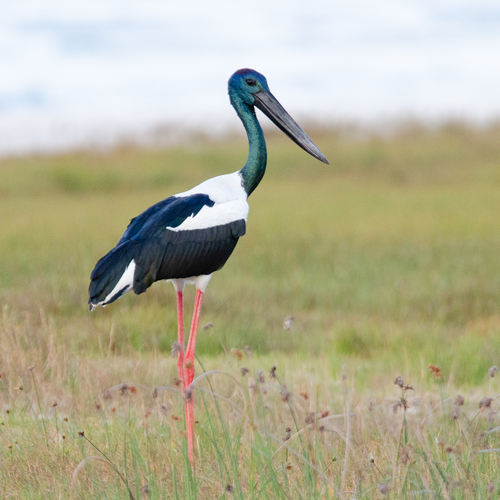
The black-necked stork (scientific name: Ephippiorhynchus asiaticus (Latham, 1790)) is a large bird that stands 129–150 cm (51–59 in) tall, with a wingspan of 230 centimetres (91 in). The only published body mass for this species comes from a single specimen recorded at 4,100 g (9.0 lb), which is nearly 35% lower than the average body mass of the closely related, similarly sized saddle-billed stork. This means the recorded specimen may have been at the lower end of the species' size range, or may have been malnourished. Plumage patterns are distinct, and younger birds differ in appearance from adults. Adult black-necked storks have glossy, iridescent bluish-black heads, necks, secondary flight feathers, and tails, a coppery-brown crown, bright white backs and bellies, black bills with a slightly concave upper edge, and bright red legs. The sexes have identical plumage, but adult females have yellow irises while adult males have brown irises. Juveniles under six months old have brownish irises, distinctly smaller, straighter beaks, a fluffy overall appearance, brown heads, necks, upper backs, wings, and tails, white bellies, and dark legs. Juveniles older than six months have a mottled appearance, most noticeably on the head and neck where iridescence is partially developed, dark-brown outer primaries, white inner primaries that form a shoulder patch when the wings are closed, a heavy beak that matches adult size but remains straighter, and dark to pale-pink legs. Like most storks, the black-necked stork flies with its neck outstretched, rather than retracted like a heron. In flight, it has a spindly appearance, and is distinguished by a black bar running through its white wings, paired with a black neck and tail; the similar-looking migratory black stork has all-black wings. In terms of distribution and habitat, the species is widespread across western India, the central highlands, and the northern Gangetic plains that extend east into the Assam valley, but is rare in peninsular India and Sri Lanka. It is an occasional straggler in southern and eastern Pakistan, and is a confirmed breeding species in central lowland Nepal. Its range extends into Southeast Asia, through New Guinea, and into the northern half of Australia. Compared to other large waterbirds including cranes, spoonbills, and other stork species, black-necked storks are least abundant in locations that have high diversity of large waterbird species. The largest overall population of this species is found in Australia, where it occurs from the Ashburton River near Onslow, Western Australia, across northern Australia to north-eastern New South Wales. Inland, its range extends through the Kimberley region to south of Halls Creek, through the Northern Territory to Hooker Creek and Daly Waters, and through Queensland inland to the Boulia area and the New South Wales border. There are records of individuals as far south as the north-west plains of New South Wales, along the coast of Sydney, and the species formerly bred near the Shoalhaven River. It is rare at the south-eastern extremity of its Australian range, but common across northern Australia. An estimated 1800 black-necked storks live in the Alligator Rivers region of the Northern Territory, and overall survey counts have found low population numbers in all seasons. A combination of aerial and ground surveys on the middle Fly River floodplain, Papua New Guinea counted 317 storks in December 1994 and 249 in April 1995. The largest known breeding population is found in the largely agricultural landscape of south-western Uttar Pradesh, India. Population density estimates for this region, which is a mosaic of cultivated fields and wetlands, are around 0.099 birds per square kilometre. Around six breeding pairs have been recorded using the 29 square kilometres of Keoladeo National Park, and one breeding pair has been observed in Bhagalpur district, western Bihar. In Sri Lanka, the species is a rare breeding resident, with 4–8 breeding pairs recorded in Ruhuna National Park. It is exceedingly rare, and possibly no longer breeds in Bangladesh and Thailand. Black-necked storks forage across a range of natural and artificial wetland habitats. They frequently use natural freshwater wetlands including lakes, ponds, marshes, flooded grasslands, oxbow lakes, swamps, rivers, and water meadows. Artificial freshwater wetlands used by the species include flooded fallow fields and paddy fields, wet wheat fields, irrigation storage ponds and canals, sewage ponds, and dry floodplains. Small numbers are also seen in Indian coastal wetland habitats, including mangrove creeks and mangrove marshes. In cultivated areas, black-necked storks prefer to forage in natural wetlands, though flooded rice paddies are preferentially used during the monsoon, likely because natural lakes and ponds become excessively flooded. Nests are usually built on trees located in secluded areas of large marshes, or in cultivated fields, as seen in India and lowland Nepal. This large stork performs a dance-like courtship or social display. A pair will stalk toward each other face-to-face, extend their wings, flutter their wing tips rapidly, and advance their heads until they meet. The pair then clatters their bills and walks away. The display lasts one minute and may be repeated multiple times. In India, nest building begins during the peak of the monsoon, with most nests started between September and November, and few new nests built after this period until January. Black-necked storks nest on large trees, which may be isolated in large marshes or located within agricultural landscapes, and build a large platform nest. In agricultural landscapes, human disturbance can cause nesting adults to abandon nests in some locations, but storks nest successfully in other locations. Nests can measure up to 3 to 6 feet across, and are constructed from sticks and branches, lined with rushes and water plants, and sometimes plastered with mud along the edges. Nests may be reused year after year. The usual clutch size is four dull white, broadly oval eggs, though clutch size can range from one to five eggs. The exact incubation period is not confirmed, but is suspected to be around 30 days. Hatchlings are covered in white down, which is replaced by darker grey down on the neck within one week. Scapular feathers emerge first, followed by the primary flight feathers. Fledged young produce a chack call, followed by a repeated wee-wee-wee call. Another recorded call is a low, high-pitched peeeeeu-peeeeu-peeeeu-peeu whistle of 10 to 12 notes, with a ventriloquistic quality. Juveniles at the nest also peep continuously to solicit food from adults. Adult birds take turns tending the nest, and when one adult returns to relieve the other, they perform a greeting display with open wings and an up-and-down head movement. Adults bring food for young chicks and regurgitate it onto the nest platform. Adults stop feeding chicks at the nest and become aggressive toward the chicks when the chicks are around 3 or 4 months old. Young birds may stay in the nearby area for around a year before dispersing. Typically, one to three chicks fledge from successful nests, though up to five chicks can fledge in years with high rainfall. Both the number of pairs that successfully raise chicks and the average size of fledged broods are strongly tied to monsoonal and post-monsoon rainfall, with better outcomes in wetter years. At nest trees, which are typically tall with large trunks and wide canopies, storks in Bharatpur competed with Indian white-backed vultures, and sometimes failed to nest because of competition from the vultures. While many wetland birds are frightened away by birds of prey, black-necked storks are not usually intimidated, and can be quite aggressive toward other large waterbirds including herons and cranes. Adults aggressively defend small deep water depressions against egrets and herons at Malabanjbanjdju in Kakadu National Park, Australia, and defend drying wetland patches against waterbirds including spoonbills and woolly-necked storks at Dudhwa National Park, Uttar Pradesh, India. The black-necked stork is a carnivore. Its diet includes waterbirds such as coots, darters, little grebes, northern shovelers, and pheasant-tailed jacanas, alongside a range of aquatic vertebrates including fish, amphibians, and reptiles, and invertebrates including crabs and molluscs. They also prey on turtle eggs and hatchlings. In the Chambal River valley, they have been observed locating nests of Kachuga dhongoka buried under sand, likely by detecting the moistness of the freshly covered nest, to prey on the turtle eggs. In Australia, black-necked storks sometimes forage at night to feed on emerging marine turtle nestlings. Stomach content analysis of nine storks in Australia found crabs, molluscs, insects (grasshoppers and beetles), amphibians, reptiles, and birds in their diet. The analyzed storks had also consumed a small piece of plastic, pebbles, cattle dung, and plant material. In well-protected wetlands in both Australia and India, black-necked storks feed almost exclusively on fish, but in the agriculture-dominated landscape of Uttar Pradesh, India, they feed on a wider range of prey including fish, frogs, and molluscs; in this region, storks catch fish in wetlands, frogs from roadside ditches, and molluscs from irrigation canals. Although the species is predominantly diurnal, it may forage at night, and has been recorded foraging on moonlit nights for sea turtle hatchlings on Australian beaches. Black-necked storks sometimes soar during the heat of the day or rest on their hocks. When disturbed, they may stretch out their necks. Their drinking behavior involves bending down with an open bill, scooping up water with a forward motion, then raising the bill to swallow. They sometimes carry water in their bill to chicks at the nest, even carrying water during nest building or egg incubation. Like other storks, black-necked storks are largely silent except at the nest, where they produce bill-clattering sounds. These sounds are low-pitched and resonant, and end with a short sigh. Fledged juveniles will occasionally call with a mildly-warbling, high-pitched series of whistles, accompanied by open, quivering wings. These calls and behaviors are directed at adult birds to solicit food, particularly in drought years when younger birds are often unable to find food on their own easily. Black-necked storks are largely non-social, and are most often seen alone, in pairs, or in small family groups. Flocks of up to 15 storks have been observed in Australia and India, and these flocks likely form due to local habitat conditions such as the drying out of wetlands. The black-necked stork is the type host for two parasite species: the ectoparasitic Ischnoceran bird louse Ardeicola asiaticus, and the endoparasitic trematode Dissurus xenorhynchi.