About Ephestia kuehniella Zeller, 1879
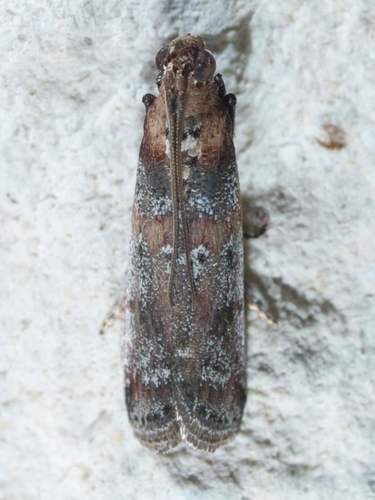
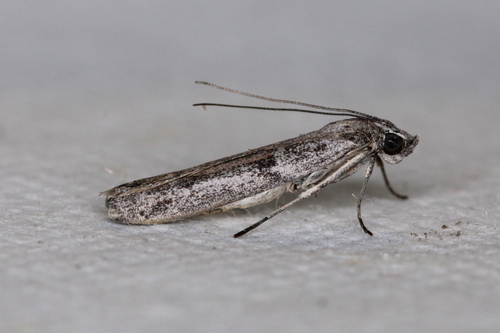
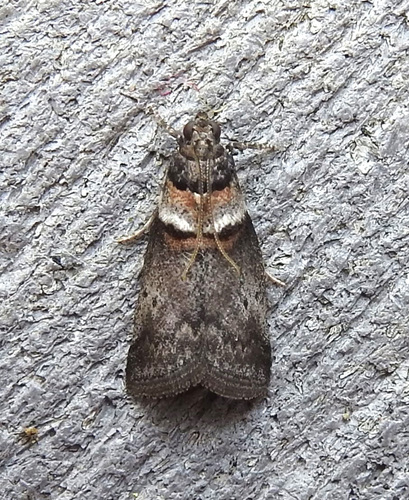
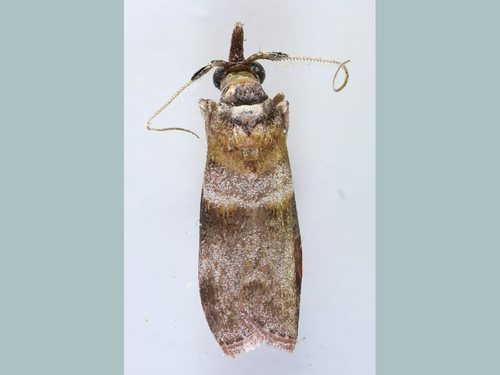
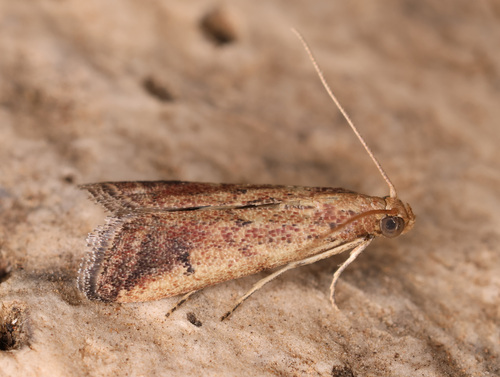
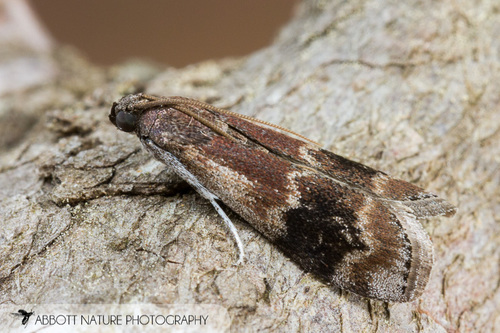
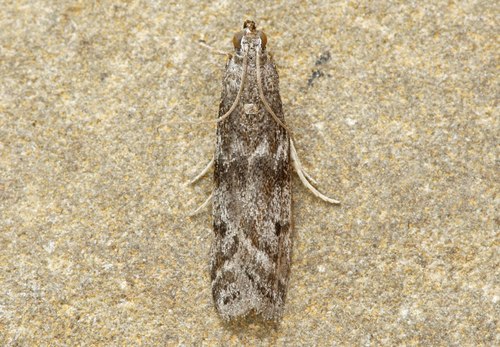
Adults of Ephestia kuehniella, commonly called the Mediterranean flour moth, have pale gray bodies. Their forewings are gray with black zigzag markings, while their hindwings are off-white, and their wingspan measures 1.5 to 2.6 cm. Larvae (caterpillars) are white or pink with black spots and dark heads, and pupae are reddish brown. A description by Meyrick notes: forewings are fuscous, dusted with whitish and sprinkled with dark fuscous; lines are barely paler, with the first line dark-edged on the posterior side, nearly straight, quite oblique, serrate-indented above the middle and near the dorsum, and the second line strongly indented near the costa, dark-edged, with darker dots on the veins; there are two blackish transversely placed discal dots. Hindwings are whitish, with veins and termen fuscous, and males lack whitish ochreous hair-tufts.
First recorded as a pest species in Germany in 1879, the Mediterranean flour moth was found in several locations across Europe in the years that followed. In the late 19th century, the spread of roller flour mills allowed the moth to become a more widespread pest. By 1980, it was a common species in Britain, North America, and Australia. Today, the Mediterranean flour moth is found throughout the world, though it tends to be rare in the Far East except for Japan. Temperate climate regions are most likely to have Mediterranean flour moth infestations in their flour mills.
Mediterranean flour moths live in stored grain products. They primarily infest flour, but can be found in a variety of cereal grains. This moth is a major pest in flour mills, and may also be found in bakeries and warehouses, especially in cereal products that have been left undisturbed for an extended period. This species particularly favors inhabiting flour mills and bakeries due to the heat, which allows it to breed year-round.
Female E. kuehniella typically lay eggs on the second night after emerging as adults. This delay occurs because they require a few hours for sperm to move from the bursa copulatrix to the vestibulum, where fertilization takes place. Females lay between 116 and 678 eggs on a food source such as flour, to which the eggs often attach. When eggs hatch, larvae spin silken tubes around themselves, and spend around 40 days maturing inside these tubes. When fully grown, larvae disperse to new locations and spin silken cocoons, where they develop into pupae. Adult moths emerge from the cocoons after 8 to 12 days. In hot weather, the moth's entire life cycle can take as little as five to seven weeks. While the species prefers warm temperatures, as it can develop more quickly in these conditions, E. kuehniella can complete its development in temperatures ranging from 12 °C to around 30 °C. E. kuehniella activity is also heavily shaped by its circadian rhythm: adult emergence most often happens during the day, while other adult activities including female calling, male courtship, mating, and oviposition typically happen at night.
Caterpillars of the Mediterranean flour moth feed on flour, meal, whole grains, and grain residues. Unlike other moth pest species, E. kuehniella is almost always found in cereal grain products, rather than other stored foods such as dried fruit. Adult Mediterranean flour moths are short-lived and do not feed.