About Ephedra aspera Engelm. ex S.Watson
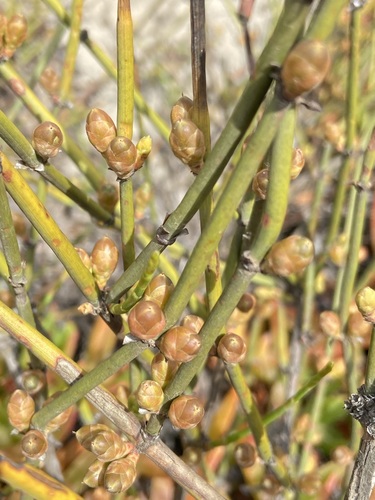
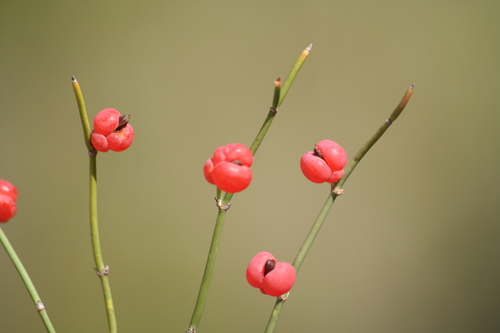
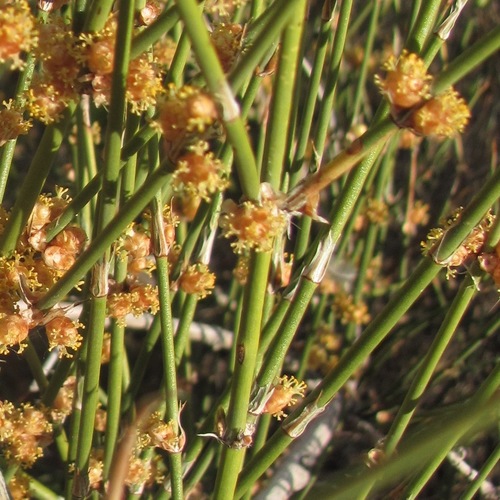
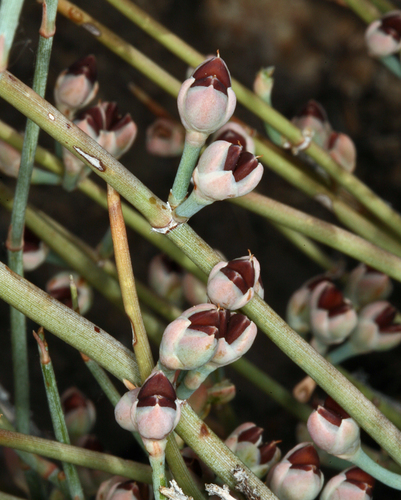
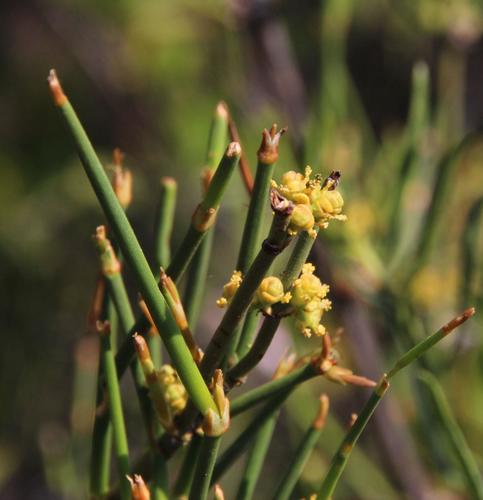
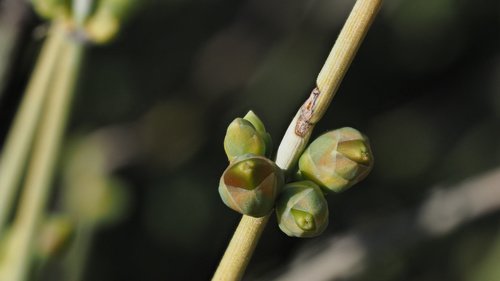
Ephedra aspera Engelm. ex S.Watson is a highly branched shrub that grows between 0.5 and 1.5 meters tall, often exceeding 1 meter in height. It is composed of many long yellow-gold twigs. Its bark is gray, cracked, and fissured. Branches are opposite or whorled, rigid, and diverge from the main stem at an angle of roughly 30 degrees. Twigs range from pale to dark green, turning yellow as they age; they are not sticky, range from slightly to strongly rough to the touch, and have numerous longitudinal grooves, with internodes measuring 1 to 6 centimeters long. Terminal buds are conic, 1 to 2 millimeters long, with an obtuse apex. The shrub's small leaves are just a few millimeters long. Leaves are most often opposite, rarely arranged in whorls of 3, and measure 1 to 3 millimeters long, occasionally reaching up to 5 millimeters. Leaves are fused together for between one half and seven eighths of their total length. Their bases are thickened, brown, shred as they age, remain somewhat persistent on the plant, and have an obtuse apex. Male plants of this species bear pollen cones that are 4 to 7 millimeters long. Pollen cones usually occur in groups of 2 at each node, rarely occurring singly or in whorls. They are obovoid, and are sessile or rarely borne on short peduncles. Their bracts are opposite, numbering 6 to 10 pairs, and range in color from yellow to red-brown. The bracts are obovate, measuring 3–4 by 2–3 millimeters, and are membranous. Bracteoles slightly extend past the bracts. Sporangiophores are 4 to 5 millimeters long, with half of their length extending outside enclosing structures, and hold 4 to 6 microsporangia that are sessile or on short stalks less than 1 millimeter long. Female plants may be darker to reddish in color, and bear seed cones that are slightly larger than the male plant's pollen cones. Each seed cone contains only one seed. Seed cones usually occur in groups of 2 at each node, are ovoid, 6 to 10 millimeters long, and are sessile or borne on short scaly peduncles. Their bracts are opposite, numbering 5 to 7 pairs, and are circular, measuring 4–7 by 2–4 millimeters. The bracts are membranous, with a thickened red-brown center and base, and have entire margins. The single seed per cone is ellipsoid, measuring 5–8 by 2–4 millimeters, ranges in color from light brown to brown, and is smooth to slightly rough.