About Epalxiphora axenana Meyrick, 1881
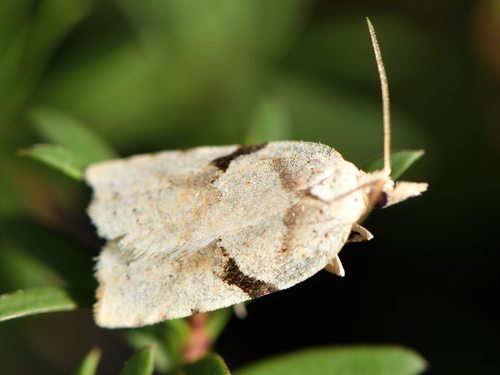
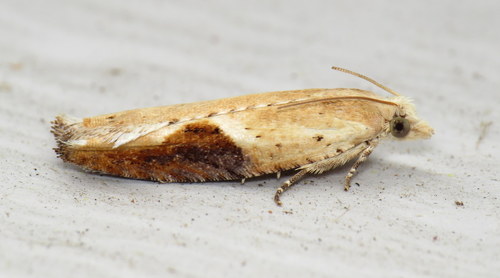
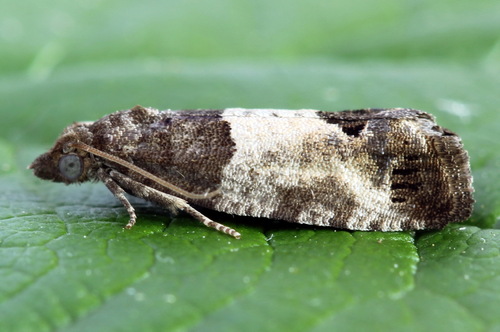
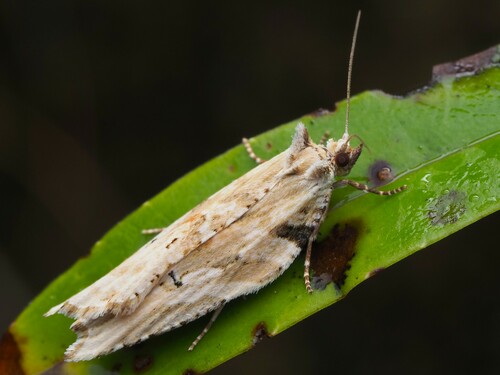
Epalxiphora axenana Meyrick, 1881 has semi-transparent green larvae, with no distinct markings apart from their yellowish head, which has brown mottling or stripes. Adults of this species show strong sexual dimorphism. Detailed adult descriptions were published by Hudson. For males, wingspan ranges from just over ¾ inch to 1+1⁄8 inches; for females, wingspan ranges from just under 1 inch to 1+1⁄4 inches. Male forewings have a slightly hooked apex and a strongly bowed termen. Their overall colour ranges from pale ochreous-brown to dull purplish-grey. The costa is broadly shaded dark brown, darkest near the middle, and usually holds an oval paler patch. Purplish colour varieties often have a large reddish patch just below the costa. There is almost always a narrow pale brown or yellowish patch on the apex, and usually a number of dark brownish marks on the dorsum. Male hindwings are pale grey, with obscure darker grey mottling. Female forewings are considerably longer and narrower than those of males, with the costa elbowed at 1/3, and a more strongly hooked apex. Female colouring and markings are much more variable than in males. The most common ground colour for females is pale brownish-ochreous or bone colour. Females have a dark brown oblong mark on the costa at one-sixth, which almost meets a pale brown wavy band on the dorsum at about 1/4. A narrow pale brown band on the costa at 1/3 almost meets a large patch of the same colour on the dorsum that extends to the tornus. From about 1/2 nearly to the apex, the costa has a narrow, irregular brown edge, which leaves a narrow, oblique apical band of the pale ground colour. The termen is more or less distinctly bordered with pale brown. Female hindwings are very pale ochreous, with faint grey mottling. The unusual shape of this moth’s forewings helps with species identification. This species is endemic to New Zealand. It was originally considered endemic only to the North Island, but has been recorded in the South Island since the mid-1980s, most likely transported there on horticultural plants or garden shrubs. It can currently be found in the South Island regions of Nelson, Buller and Westland. This species prefers native forest as its habitat. Larvae feed on a wide range of shrubs, including Griselinia littoralis, Myrsine salicina, Piper excelsum, Didymocheton spectabilis, and also Citrus species.