About Epacris longiflora Cav.
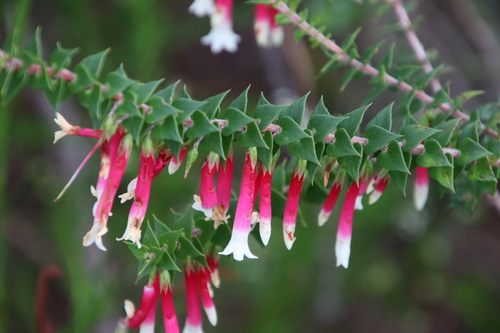
Epacris longiflora Cav. is an erect to spreading shrub that reaches a height of 50 to 200 cm (20 to 80 in). Its stems have prominent, short, broad leaf scars. The leaves are egg-shaped, 5.6 to 17 mm (0.2 to 0.7 in) long, 3 to 6.6 mm (0.1 to 0.3 in) wide, and end in a pointed tip. They are thin and flat, with margins that bear tiny teeth. Flowers are red with white tips, though some are entirely red, and each grows from a peduncle up to 2 mm (0.08 in) long. There are five petals fused into a tube with five lobes at the end; the tube measures 12 to 27 mm (0.5 to 1 in) long and 5 to 6 mm (0.20 to 0.24 in) in diameter, while the lobes are 2.4 to 4.4 mm (0.09 to 0.2 in) long. At the base of the petal tube are whorls of bracts, plus five sepals 4.5 to 6 mm (0.18 to 0.24 in) long. Inside the petal tube sits a central style, with the stigma at its tip and an ovary at its base; the stamens are hidden entirely within the tube. Flowering occurs year-round, with fewer flowers produced during summer. The fruits are capsules 3 to 4 mm (0.1 to 0.2 in) long that contain small, light seeds. Commonly called fuchsia heath, this species occurs on the coast and tablelands from south-eastern Queensland to Berry in New South Wales. It grows in sandy soil on cliff faces, in heath, at woodland margins, and in dry sclerophyll forest. Wild individuals of this species are thought to live between 5 and 20 years. A well-regarded ornamental garden plant, E. longiflora was first cultivated in England in 1803. It will grow in a range of soil types as long as drainage is good, and performs best in a partly shaded location. Like other species in the Epacris genus, Epacris longiflora was initially difficult to grow and maintain in the original soil at the Australian National Botanic Gardens in Canberra.