About Epacris impressa Labill.
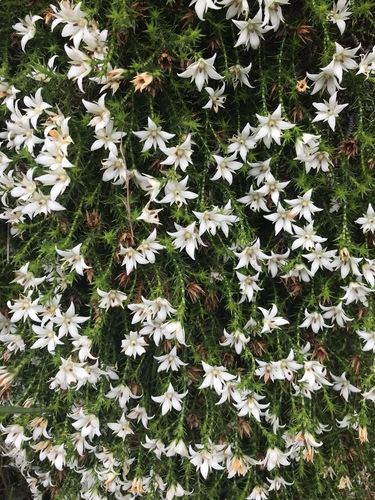
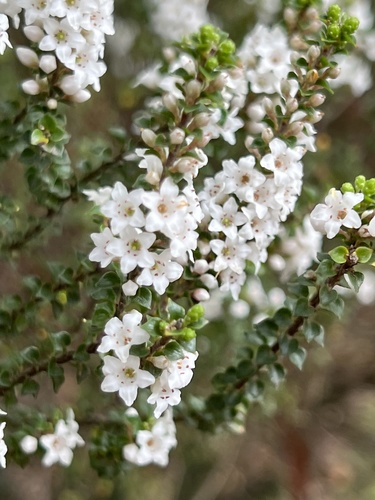
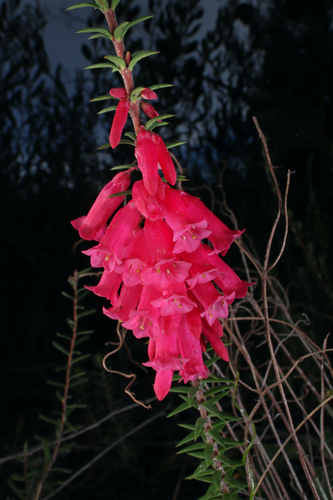
Epacris impressa Labill. is an upright woody shrub. It can reach 2 to 3 metres (6 ft 7 in to 9 ft 10 in) in height, though plants 0.5 to 1 metre (1 ft 8 in to 3 ft 3 in) tall are more common. It has stiff branches bearing small leaves with prickly, pointed tips that measure 8–16 mm (3⁄8–5⁄8 in) long. Flowering occurs mainly from late autumn to early spring. Flowers grow in dense, sometimes pendulous clusters along stems. They are white, pink, or red, 1–2 cm (3⁄8–3⁄4 in) long, and narrow and tubular, with five indentations at their base. The flower's corolla is made of five petals, fused at the base to form a tube, with unfused petal tips forming five lobes at the apex. Five whorled sepals sit at the base of the corolla. Inside the corolla is a central style that remains through fruit development; the style connects the stigma at the apex to the ovary at the base, where nectar is also stored. Different colour forms are often found growing close together. The fruit is a globular 5-locule capsule around 3.5 mm (1⁄8 in) in diameter, sometimes flattened at one end. It starts green, then dries and splits open to release many tiny seeds. This species is commonly found in coastal regions and adjacent foothills, with a distribution that ranges from Kangaroo Island and the southern Mount Lofty Ranges in South Australia across southern Victoria, extending to the Grampians and the Little Desert, and north to southern New South Wales as far as the Clyde River in the Budawang Range. It is also widespread across Tasmania. It has been recorded at altitudes up to 1,200 metres (3,900 ft) at Mount Stradbroke and Mount Tingaringy in East Gippsland. It grows in a wide diversity of habitats, including sand and clay heathland, herb-rich and heathy woodland, lowland and shrubby dry forests, riparian thickets, montane rocky shrubland, and rocky outcrops. Honeyeaters such as the eastern spinebill are attracted to E. impressa's flowers. When a bird collects nectar, the finned pollen attaches to feathers on the bird's head and is carried to other flowers, facilitating cross pollination. One study in forests near Hobart, Tasmania found that eastern spinebills arrived in the area when common heath (the common name of Epacris impressa) flowered in March, and left once flowering ended. Other honeyeater species, including the strong-billed, crescent, and yellow-throated honeyeaters, occasionally feed on common heath flowers. Field work in the Mount Lofty Ranges of South Australia recorded white-plumed honeyeaters, New Holland honeyeaters, crescent honeyeaters, and eastern spinebills visiting the flowers. Insects recorded visiting white-flowered E. impressa plants include the Australian painted lady (Vanessa kershawi), yellow admiral (Vanessa itea), and bees. Field work in southern Tasmania found that the introduced bumblebee (Bombus terrestris) sometimes steals nectar by piercing the base of the flower tube, which allows introduced honeybees (Apis mellifera) to access nectar through the same hole. Epacris impressa is a host species for the scale insect Lecanodiaspis microcribraria. A 1971 study of Phytophthora cinnamomi pathogen invasion into Victoria's Brisbane Ranges National Park indicated that E. impressa is moderately susceptible to this pathogen, a finding confirmed by seedling inoculation tests. 1985 fieldwork in the same park found some evidence that E. impressa seedlings can recolonize areas that were infested with P. cinnamomi ten years earlier. Epacris impressa can regenerate after bushfire both from seed and by resprouting. Field work in Otway Ranges heathland in the years after the 1983 Ash Wednesday bushfires found that large numbers of E. impressa seedlings grew in some areas, and flowering occurred as early as the second year after the fire. Fungi colonize the roots of Epacris impressa to form ericoid mycorrhiza, and fungal species associated with the plant are thought to differ between regions. Common heath was first introduced to cultivation in England by the Clapton Nursery in 1825, propagated from seed collected by William Baxter in southern Australia. Because it is sensitive to frost, it was mostly limited to greenhouse cultivation in England. In 1873, a variety called Epacris impressa alba was recorded being commercially grown for cut flowers in Boston, United States. While the species was initially popular, with over seventy cultivars documented in literature at the time, most cultivars have since been lost. In cultivation, common heath grows best in moist, well-drained acidic soil, and adding peat to the growing medium is beneficial. It can be grown in coastal gardens in a sheltered position, and generally requires some shade. Once established, plants can tolerate short periods of dry conditions. As plants age, they may become straggly, but they respond well to hard pruning after fertilizing and watering, which encourages compact, bushier new growth. Common heath can be short-lived and difficult to transplant, but it can be easily grown as a pot plant. Like other species in its genus, Epacris impressa was initially difficult to grow and maintain on native soil at the Australian National Botanic Gardens in Canberra. Propagation by both seed and cuttings is difficult, which limits commercial production by plant nurseries. Germination rates of soil-stored seeds increase substantially after treatment with heat and aqueous smoke solutions. The best cutting propagation results are obtained by using new tip growth collected six weeks after flowering stops, kept under a fogging system for twenty weeks. Plantsman Neil Marriott recommends using semi-hardened cutting material collected in spring and autumn. The roots of cuttings are brittle and easily damaged.