About Eopsaltria griseogularis Gould, 1838
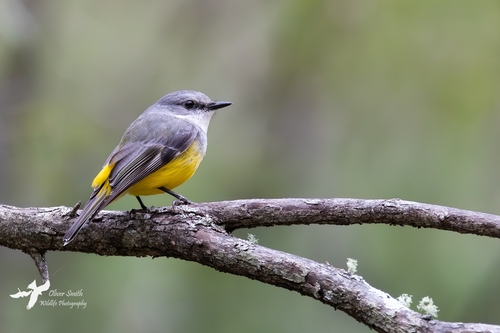
The western yellow robin, Eopsaltria griseogularis Gould, 1838, measures 13.5 to 15.5 cm (5+1⁄4 to 6 inches) in length, with a 24 to 27.5 cm (9+1⁄2 to 10+3⁄4 inch) wingspan, and an average weight of 20 g (0.7 oz). Males and females are alike in both size and plumage, and there is no seasonal change to their feathers. Adult individuals have grey heads, necks, and upper body, with a white throat that fades into a grey breast. They have black lores, paler grey eyebrows, and faint pale streaking across the ear coverts. Their underparts are yellow, with a clear boundary separating this area from the grey breast. For the nominate subspecies, the rump and upper tail coverts are yellow, while these areas are olive-green for subspecies rosinae. A broad zone of intermediate coloration exists between the core ranges of the two subspecies. Subspecies rosinae birds overall have longer wings and tails, plus a shorter bill and tarsus. Individuals from the west coast between Cliff Head and Kalbarri are significantly smaller overall. Intermediate forms between the two subspecies occur across a broad band that runs southeast from Lancelin and Jurien Bay through the inner Wheatbelt to the coast between Denmark and Fitzgerald River National Park.
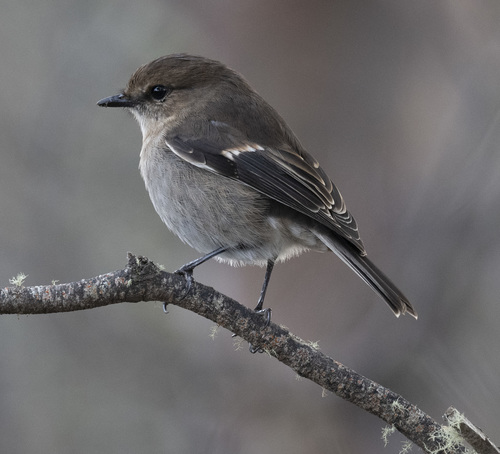
Juvenile western yellow robins have dark brownish heads, necks, and upper parts, marked with coarse creamy white streaks, and black lores. Their chin and throat are grey-white, their breast is a mix of cream and brown, and their belly is white or off-white with a brown tinge. Juveniles molt after a few months into immature plumage, which resembles adult plumage but retains some brownish flight feathers and secondary coverts on the wings and tail.
The song of the western yellow robin consists of sequences of extended whistles, opening with two short piped notes. This song is often heard before dawn, described as having a mournful quality, and it is a well-known sound in southwest Australian forests and woodlands. The species also gives a scolding call transcribed as ch-churr or churr-churr, plus a two-syllabled zitting call. Around the nesting period, the female gives a courtship or food-begging call made up of a long note followed by a deeper staccato note. No other species within the western yellow robin's range resembles it. The closely similar eastern yellow robin occurs only in Australia's eastern states. Immature western yellow robins closely resemble immature white-breasted robins (Quoyornis georgianus), though young individuals of both species are typically near their own parents. Young western yellow robins also have an olive tinge on the edges of their flight and tail feathers, and develop yellow belly feathers as they molt out of juvenile plumage.
In terms of distribution and habitat, the western yellow robin is found in Western Australia south and west of an imaginary line between Kalbarri and Norseman. It is largely absent from the coastal plain between Dongara and Rockingham, and is a rare vagrant as far north as Shark Bay and Toolonga Nature Reserve. Along the southern coastline, it occurs in a fragmented distribution up to the South Australian border, at Eucla, Hampton Tableland, and the Roe Plains. In South Australia, it ranges from Yalata east to the Eyre Peninsula, extending north to the Gawler Ranges and east to the Middleback Range. The species is sedentary throughout its entire range. The nominate subspecies Eopsaltria griseogularis griseogularis ranges across coastal southwest Western Australia from Lancelin in the north, inland to Northam, and southeast to King George Sound. Subspecies Eopsaltria griseogularis rosinae occurs from Jurien Bay and Tamala, then inland across the Wheatbelt and Goldfields to the southeastern Western Australian coastline, across the Great Australian Bight, and on the Eyre Peninsula.
Within its range, the western yellow robin lives in eucalypt forest and woodland, as well as mallee and acacia shrubland in drier semi-arid regions. Fieldwork conducted in Dryandra Woodland found that the species favors locations with a thicker canopy, a thicker leaf litter layer, and logs. Leaf litter and logs directly provide habitat for the insects that the western yellow robin feeds on, while a thicker canopy creates cooler ground temperatures and supports more leaf litter, both of which also benefit insect populations. The presence of wandoo trees (Eucalyptus wandoo) and shrubs of the genus Gastrolobium also indicates areas with thicker leaf litter. The species avoids woodland areas that border adjacent farmland, as these areas have thinner leaf litter layers. In tall jarrah-marri forest, it generally stays in the midstory of bull banksia (Banksia grandis) or among understory shrubs.