About Eobania vermiculata (O.F.Müller, 1774)
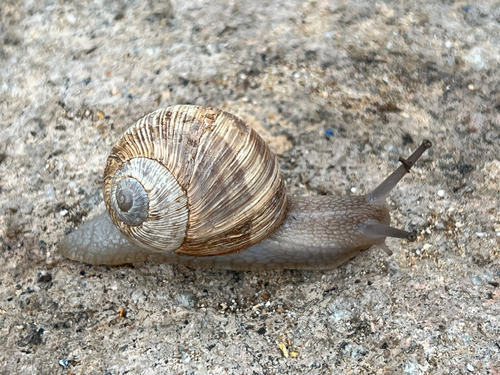
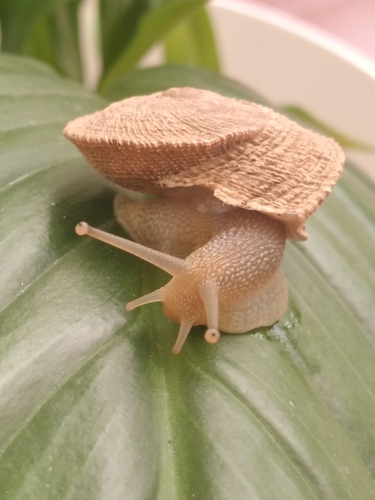
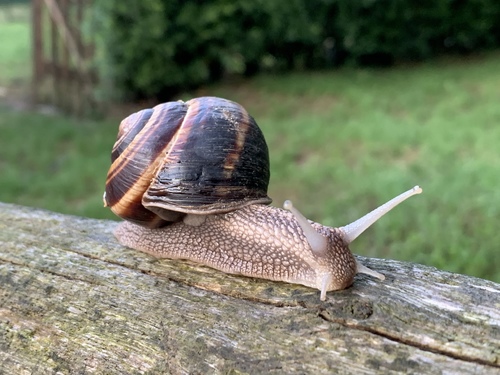
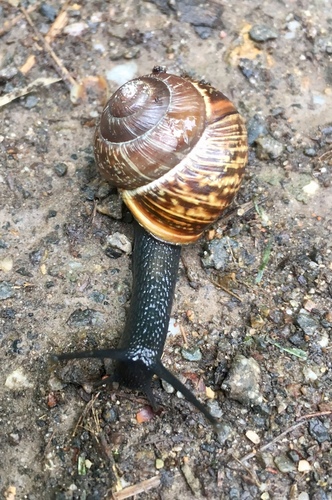
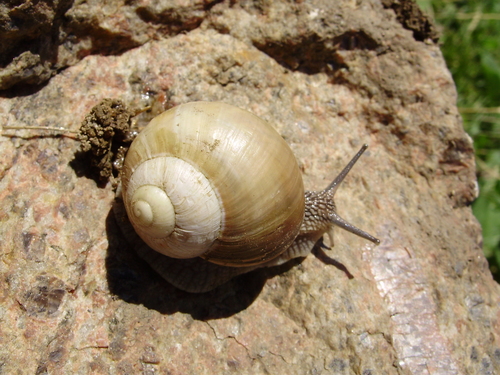
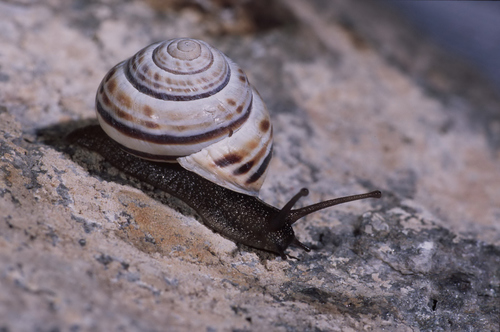
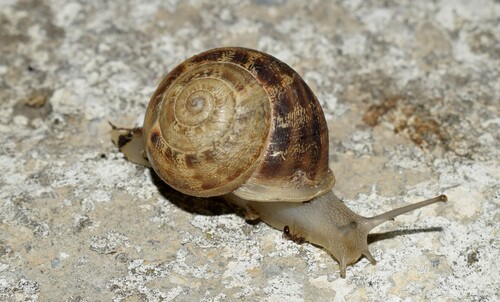
Eobania vermiculata (O.F.Müller, 1774) is a species of large land snail. The color of its shell is variable: the background color ranges from whitish to greenish yellow, and the shell often has darker bands or spots. The ventral side of the shell frequently has two brown bands, with the area between the lowest band and the umbilicus being whitish. The shell has 4 to 4.5 whorls, and the last whorl descends abruptly below the shell’s periphery. The apertural margin is white and reflected (turned back) in adult shells; in juveniles, this reflection is only present on the columellar side. The umbilicus is narrow and open in juveniles, and is only partly covered by the reflected columellar margin; in adult shells, the umbilicus is completely closed. The shell width is 22–32 mm, and the shell height is 14–24 mm. In populations of this species from northern Greece, variability seems to be lower than in populations from southern Greece. On Gavdos Island (southern Greece), adult shells have a diameter of 24.5–33.5 mm, with an average of 28–29 mm, and there are no local variations in shell size. Juvenile Eobania vermiculata somewhat resemble Theba pisana, which also has a similar umbilicus, but Eobania vermiculata can be distinguished from Theba pisana by its much larger apex. This species is native and common across the Mediterranean area, with a native distribution ranging from eastern Spain to Crimea, including eastern Bulgaria, southern Greece, Ukraine (Crimea), Egypt, Israel, and eastern Spain. It has non-native introduced populations in many locations, including southeastern Australia (where it is called the chocolate-band snail), Belgium, Germany, Hungary, the Netherlands, the United States, Japan, South Africa, Saudi Arabia, Jordan, and Iran. A single individual was found on a wall in Lewisham, London, England in 2006, and it is unknown whether a colony will become established there. Eobania vermiculata is already established in the United States, where it is considered a potentially serious pest and invasive species that could negatively impact agriculture, natural ecosystems, human health, or commerce. For this reason, it has been suggested that the species be given top national quarantine significance in the USA. This snail is able to survive winters in the temperate zone of Northwest Europe, including Belgium and the Netherlands. Eobania vermiculata lives in a broad variety of habitats, usually in dry vegetation, mainly near the coast, and also in agricultural crops. It is very common on Crete, and lives on practically every small island in the south Aegean. In northern Greece, copulation occurs after the first autumn rainfalls. These snails produce and use love darts as part of their mating behavior. Approximately 20 days after mating, each snail lays around 70 eggs. Each egg measures 4.1 × 3 mm. Juveniles hatch shortly after egg-laying, and grow about 12–13 mm in diameter per year for 2 years. In northern Greece, growth is usually restricted to the period from February to June; in Crete, this growth period ends as early as May. Maturity is reached after 2 years, when the shell diameter reaches 25 mm, the umbilicus becomes closed, and the apertural margin becomes reflected. In northern Greece, snails reach 29–30 mm in diameter by May or June of the second year; in Crete, this occurs in April. Reaching a maximum diameter of 33 mm may take 5 years or more, but mortality increases greatly after 2 years. About 20% of snails in a population survive to lay eggs in the third year, and 5% of snails lay eggs again in the fourth year. Mortality rates decrease with age. In northern Greece the snails hibernate, while in Crete they aestivate, and juveniles and adults differ in their overwintering/aestivation behavior: adults dig into the soil and build an epiphragm, while juveniles seek protected spots under stones or leaves of low plants. This species is used for human consumption. It is commercialized and exported from Greece to France, which led Lazaridou-Dimitriadou & Kattoulas (1981) to propose restrictions on the collection size and collection season for this species.