About Enyalioides laticeps (Guichenot, 1855)
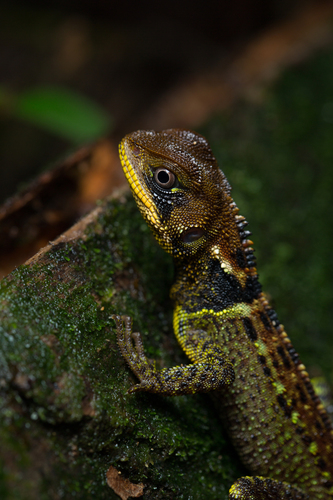
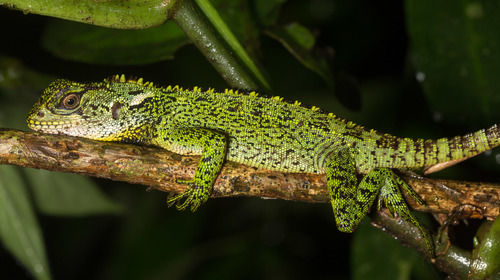
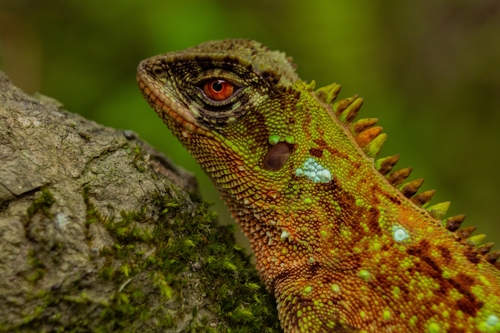
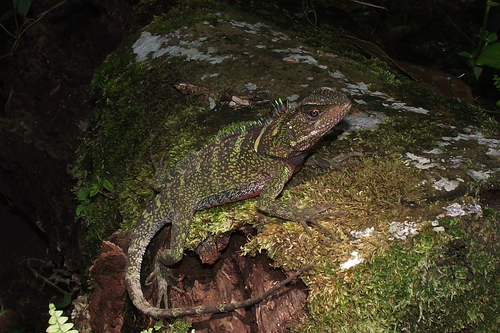
Enyalioides laticeps, commonly called the Amazon broad-headed wood lizard, is a dwarf hoplocercid lizard. This species has a continuous vertebral crest of spines running along its entire body; the crest is conspicuously high and well developed on the nape (back of the neck), but low on the dorsal half of the body. Males reach a maximum snout-to-vent length (SVL) of 157 mm, while females reach a maximum SVL of 130 mm. The head is relatively large, measuring between one-quarter and one-third of the lizard’s SVL. It has the four-sided pyramidal head shape typical of Enyalioides lizards, with two ridges formed by the projecting supraciliaris (the area above the eyes/eyebrows). Head width is approximately 0.7 to 0.9 times head length, giving the species a proportionally wide head that gives it the common name "broad-headed wood lizard". The body is laterally compressed. Forelimbs are well developed, and hind limbs are long. The tail is long, measuring 1.5 to 1.9 times the lizard’s SVL. Like other Enyalioides species, E. laticeps can change color when disturbed, shifting its green tones to brown tones, a trait called metachromatism. Dorsal scales range in color from dull green to tan to brown, and often have blueish areas. Ventral scales range from white to cream to tan. In males, the gular region (ventral throat area, which is relatively inconspicuous in Enyalioides) may be dark brown or black. The overall body coloration is often predominantly spotless, but more commonly has lighter or darker patterns overlaid. These patterns can be a dark brown or reddish-brown reticulate (net) pattern spread across the dorsolateral surfaces of the body, limbs, and tail; in some individuals this reticulate pattern is faint and inconspicuous. Patterns may also be chevrons (V-shaped or inverted V-shaped) with alternating light and dark color, overlaid on a dorsal longitudinal series of large, oval, light-colored areas. Sometimes the pattern is simply scattered, irregular light spots. Juvenile males may have a pattern of convergent brown lines that run toward, but do not reach, the lizard’s chin (mental area). The ventral region is usually unspotted or only sparsely spotted. Males can be identified by a 2–3 scale-wide strip of cream, white, or orange color. All members of the genus Enyalioides (wood iguanas) are dwarf species, so multiple wood lizard species sharing similar sizes, appearances, behaviors, and habitats occur in the Amazon basin. Torres and Avila-Pires established diagnostic features to distinguish the Amazon broad-headed wood lizard from related species: (1) this species has homogenous (uniformly sized) dorsal and lateral scales, while other species have dorsal and lateral scales that increase in size posteriorly within each caudal segment; (2) this species lacks mucrones (sharp tips) on its scales, while the larger caudal scales of other species have mucrones or another type of projection; (3) it is the only Enyalioides species with a smooth tail that is almost circular in cross-section; (4) most male E. laticeps have a 2–3 scale-wide longitudinal stripe of cream, white, or orange that runs from the mouth commissure (junction of the upper and lower lips) to a point below the tympanum (eardrum); (5) adult individuals of this species have a higher middorsal crest than other Enyalioides species; (6) the species with the most similar coloration is E. praestabilis, which lacks the horizontal pale-colored lip stripe.
This species is native to the Neotropics, distributed across the upper western Amazon basin in Colombia, Ecuador, Peru, and Brazil. It is abundant in primary forests, and sometimes occurs in secondary forests (forests regenerated after disturbance to original vegetation by human or natural causes), at elevations between 80 and 1600 m. The Amazon broad-headed wood lizard is reported to be sympatric (occupy the same geographic area without interbreeding) with multiple other species across its range. In Ecuador it has been recorded as sympatric with E. cofanorum, E. microlepis, and E. praestabilis. In southern Peru it has been recorded as sympatric with E. palpebralis, Morunasaurus annularis, and M. peruvianus. It is presumed to be sympatric with these species across most of its distribution range.
The Amazon broad-headed wood lizard is semi-arboreal, meaning it lives in both trees and on the ground. It is most commonly found in primary forests, and sometimes occurs in secondary forests on low vegetation. During the day, it is mainly observed on small tree trunks with diameters less than 15 cm. At night, it sleeps on vegetation such as branches, palm fronds, or sapling trunks 30–240 cm above the ground, and sometimes sleeps inside ground burrows or retreats into shallow forest floor holes overnight. While sleeping at night, the lizard holds a horizontal position and hugs thin sticks. In one observational study of its sleeping behavior, flashlights and nearby humans did not disturb the lizards, which switched between two sleeping sites within a small area over the seven nights of observation. This species is diurnal (active during the day), sunlight-loving, and omnivorous, feeding on both plants and animals. It moves by running. When threatened, it may stay motionless, flee, or perform a threat display: it inflates its gular pouch (ventral throat region) to reveal dark red or black scale patches, and displays its jaws and teeth, though it rarely attempts to bite. It usually uses crypsis to avoid predators, and shifts to brown tones from green when disturbed, displaying its metachromatic color change.