About Entosphenus tridentatus (Richardson, 1836)
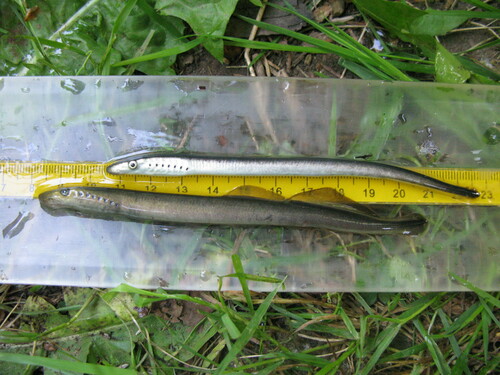
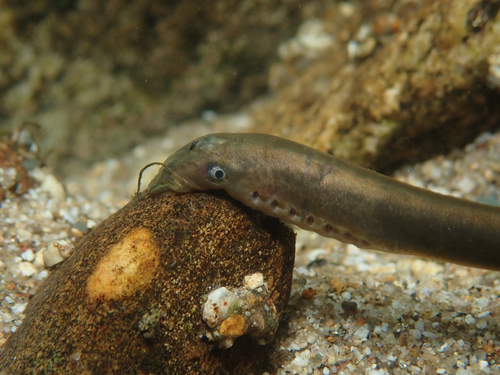
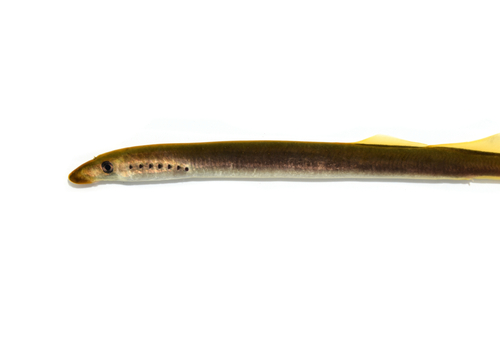
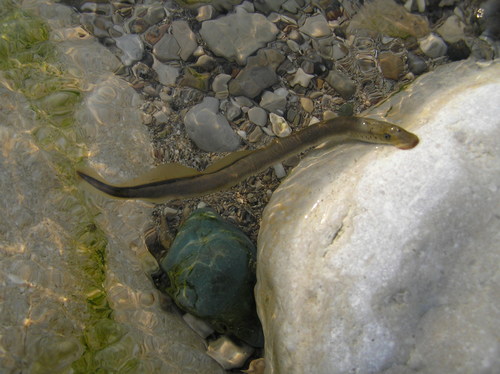
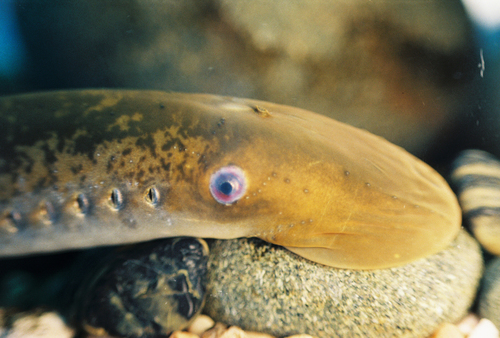
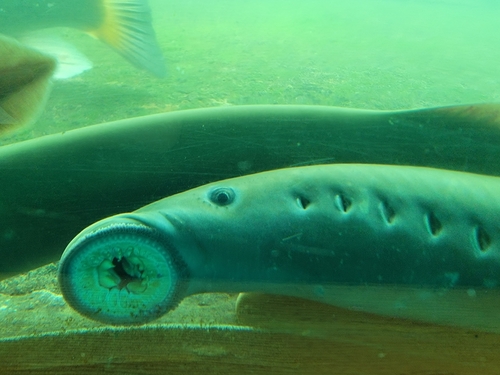
Entosphenus tridentatus, commonly known as the Pacific lamprey, belongs to the family Petromyzontidae, and is one of six species in the genus Entosphenus. Adult Pacific lampreys grow to approximately 80 cm (31 in) in length. They are anadromous and semelparous. They have slender, elongated bodies, with two dorsal fins that develop far back along the body. During the larval stage, the dorsal fins are connected; after metamorphosis, they split into two distinct separate dorsal fins. The anal fins are rudimentary, and the lower lobe of the caudal fin is larger than the upper lobe. Both lobes of the caudal fin are continuous with the dorsal fin and the anal fin. Open ocean adult Pacific lampreys are bluish-black or greenish on their upper body and pale on their underside, while adults that reside in fresh water are brown. This species is distinguished by three (or occasionally two) sharp teeth on the supraoral bar above the mouth, and three sharp points on each lateral plate. Pacific lampreys are most often found at sea, frequently far offshore, at depths ranging from near the surface to 1,508 m (4,946 ft). Pacific lampreys are native to the Pacific Rim, occurring between the Pacific coast of North America and the Bering Sea coasts of Asia. Along the North American coast, they can be found from Alaska south to Baja California, Mexico. In North America, they inhabit streams and rivers within several major river systems, including the Fraser, Columbia, Klamath-Trinity, Eel, and Sacramento-San Joaquin rivers. Pacific lampreys are an important ceremonial food source for Native American tribes in the Columbia River basin, as well as the Yurok and Karuk people of the Klamath River, and the Wiyot people of the Eel River in northern California. Pacific lamprey populations in the Columbia River have declined sharply following the construction of the Columbia River hydropower system. Almost no harvest opportunity remains for Native American communities in the Columbia River and its tributaries, except for a small annual harvest at Willamette Falls on the Willamette River, a tributary of the Columbia River. The Yurok and Wiyot people catch lampreys in the surf at the mouth of the Klamath River, often at night, using hand-carved wooden hooks. This is dangerous work. Because Pacific lampreys are fatty and have a very high caloric content, tribes including the Wiyot and Yurok have traditionally fed them to babies and young children. In tribal cuisine, lampreys are often smoked over open fires; this method enhances flavor and aids in preservation, allowing the fish to be stored and consumed over long periods. Smoked lamprey is a staple food, featured at many communal feasts. Some tribal communities also prepare lamprey in stews, combining the meat with herbs and vegetables. The high caloric content of Pacific lampreys also makes them an important part of the river ecosystem, as other animal species rely on them as a food source. Pacific lampreys hold deep cultural and spiritual importance for many indigenous tribes of the Pacific Northwest. They are recognized as essential components of the ecosystem, acting as both predators and prey. Tribes have traditional stories that discuss the lamprey's ecological and cultural significance. Historically, the presence or absence of lampreys in specific waterways was sometimes interpreted as an omen. The documentary film The Lost Fish documents how modern tribal communities are actively studying, breeding, and working to restore Pacific lampreys and their habitats in the waterways of the Pacific Northwest.