About Entomyzon cyanotis (Latham, 1801)
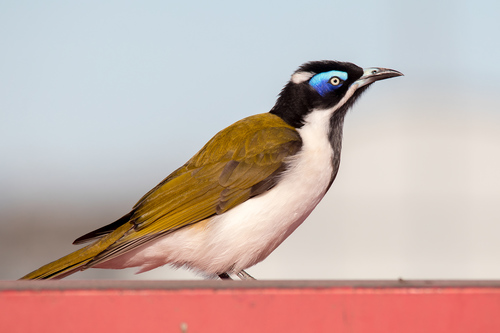
This species, the blue-faced honeyeater, has the scientific name Entomyzon cyanotis (Latham, 1801). It is a large honeyeater that measures 26 to 32 cm (10 to 12.5 in) in total length, with an average length of 29.5 cm (11.6 in). Adult blue-faced honeyeaters have a wingspan of 44 cm (17.5 in) and weigh around 105 g (3.7 oz). In terms of general shape, it has broad wings with rounded tips and a medium, squarish tail. Its sturdy, slightly downcurved bill is shorter than the skull, and measures 3 to 3.5 cm (1.2 to 1.4 in) in length. The species is easily recognized by the bare blue skin that surrounds its eyes. Apart from this facial skin, the head and throat are predominantly blackish, with a white stripe around the nape and a second white stripe running from the cheek. The upperparts, which include the mantle, back and wings, are golden-olive. The margins of the primary and secondary coverts are a darker olive-brown, while the bird’s underparts are white. Recently fledged juvenile blue-faced honeyeaters have grey heads, chins, and central breast areas, with brown upperparts and white underparts elsewhere. After their next moult, they look much more similar to adults and share similar plumage, but can still be distinguished by their facial patches. The bare facial skin of newly fledged birds is yellow, and sometimes has a small patch of blue in front of the eyes. For birds six months and older, the facial skin has usually become more greenish, then turns darker blue beneath the eye, before developing the full adult blue facial patch at around 16 months of age. The blue-faced honeyeater begins its moult in October or November, starting with its primary flight feathers, which it finishes replacing by February. It replaces its body feathers any time between December and June, and replaces its tail feathers between December and July. Between 1953 and 1997, 422 blue-faced honeyeaters were banded to track their movements and longevity. Of these banded birds, 109 were eventually recovered. 107 of the recovered individuals were found within 10 km (6.2 mi) of their original banding location. The maximum recorded longevity for the species belongs to a bird banded in May 1990 in Kingaroy, central Queensland. This bird was found dead on a road in September 1998, after 8 years and 3.5 months, and was located around 2 km (1.2 mi) from its banding site. The blue-faced honeyeater produces a variety of calls. It makes a piping call around half an hour before dawn, which has been variously described as ki-owt, woik, queet, peet, or weet. During the day, it makes squeaking noises while flying, and harsh squawks when mobbing. Its calls have been compared to those of the yellow-throated miner (Manorina flavigula), but are deeper in tone. Blue-faced honeyeaters make soft chirping sounds when near nestlings and family members. The blue-faced honeyeater is a distinctive bird. Its coloration differs from the duller-plumaged friarbirds, miners and wattlebirds, and it is much larger than similarly colored Melithreptus honeyeaters. The subspecies albipennis, which has a white wing patch, has been compared to a khaki-backed butcherbird when in flight. In Australia, the blue-faced honeyeater is found from the Kimberleys in northwestern Australia eastwards across the Top End and into Queensland. In Queensland, it occurs from Cape York south across the eastern and central parts of the state, roughly east of a line connecting Karumba, Blackall, Cunnamulla and Currawinya National Park. It has a patchy distribution in New South Wales, where it occurs in the Northern Rivers and Northern Tablelands regions, and along the coast south to Nambucca Heads. A single individual was observed in Collaroy, on Sydney’s northern beaches, on 22 September 1924. To the south, the species is generally absent from the Central and South Coast of New South Wales. Instead, it is found west of the Great Divide across the South West Slopes and Riverina to the Murray River. It is common in northern Victoria and reaches Bordertown in southeastern South Australia, where its range continues along the Murray. It is also found in the Grampians region, particularly near the towns of Stawell, Ararat and St Arnaud, with rare reports from southwestern Victoria. The species occasionally reaches Adelaide, and there is a single record from the Eyre Peninsula. It occurs at altitudes ranging from sea level to around 850 m (2,790 ft), and rarely reaches 1,000 m (3,300 ft). In New Guinea, the blue-faced honeyeater is found from Merauke in the far southeast of Indonesia’s Papua province and east across the Trans-Fly region of southwestern Papua New Guinea. It has also been recorded from the Aru Islands. The blue-faced honeyeater is generally sedentary across most of its range, especially across much of the Northern Territory, Queensland and New South Wales. However, in many locations generally south of the Tropic of Capricorn, populations may be present at some times of year and absent at others. This pattern comes from nomadic movement, rather than regular seasonal migration. Around Wellington in central New South Wales, birds were recorded over the winter months, and were more common in autumn around the Talbragar River. Birds were present year round near Inverell in northern New South Wales, but were noted to fly eastwards from January to May, and westwards in June and July. In Jandowae in southeastern Queensland, birds were regularly recorded flying north and east from March to June, and returning south and west in July and August. They were completely absent from this area in spring and summer. Blue-faced honeyeaters live in rainforest, dry sclerophyll (Eucalyptus) forest, open woodland, Pandanus thickets, paperbark stands, mangroves, watercourses, and wetter areas of semi-arid regions. They also occupy parks, gardens, and golf courses in urban areas. In eucalypt-dominated woodland where the blue-faced honeyeater occurs, the understory is most commonly made up of grasses such as Triodia. In some cases, the understory is composed of shrubs or small trees, such as grevilleas, paperbarks, wattles, Cooktown ironwood (Erythrophleum chlorostachys) or billygoat plum (Terminalia ferdinandiana). One study conducted in Kakadu National Park found that blue-faced honeyeaters inhabited mixed stands of eucalypts and Pandanus, but were completely absent from pure stands of either of these plants.