About Entoloma sinuatum (Bull.) P.Kumm.
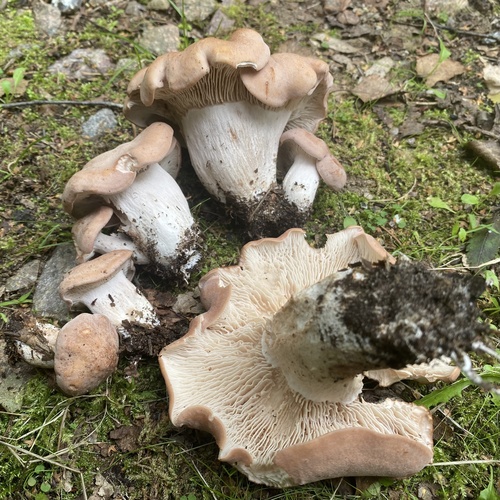
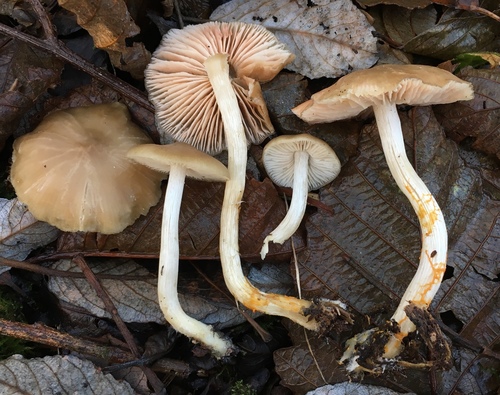
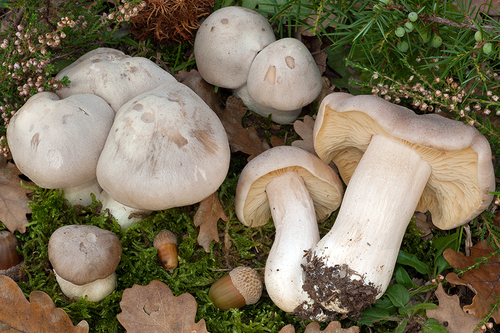
Entoloma sinuatum is the largest species in the Entoloma genus, and produces a large above-ground fruiting body (basidiocarp). Its cap ranges from 6–20 cm (2+1⁄2–6 in) wide, though the largest recorded cap reaches 30 cm (12 in) in diameter. The cap shape is convex to flat, often with a blunt umbo at the centre and wavy margins; its colour ranges from ivory white to light grey-brown, and darkens as the mushroom ages. The gills are widely spaced, and are sinuate (notched where they attach to the stipe) to almost free. They are generally, but not always, yellowish white when young, before darkening to pink then red. Short gills that do not reach the stipe from the cap margin, called lamellulae, are interspersed between the full-length gills. Viewed from below, a characteristic groove nicknamed a "moat" circles the stalk in the pattern of the gills. A rare but widespread form without yellow gill colour has been recorded from Austria, France and the Netherlands. The stout white stipe has no ring, measures 4 to 20 cm (1.6 to 7.9 in) tall and 0.5–4 cm (0.20–1.57 in) in diameter, and may be bulbous at the base. The taste is mild, though it can be unpleasant. The mushroom has a strong, unusual odour that is difficult to characterize; it may smell like flour, but is often unpleasant and rancid. It produces a reddish-brown spore print. Its spores are angular, measuring 8–11 × 7–9.5 μm, and are roughly six-sided and globular in shape. The basidia are four-spored and clamped. The gill edge is fertile, and cystidia are absent. Entoloma sinuatum is fairly common and widespread across North America, ranging as far south as Arizona. It also occurs throughout Europe, including Ireland and Britain; it is more common in southern and central Europe than in the northwest. In Asia, it has been recorded in the Black Sea region, Adıyaman Province in Turkey, Iran, and northern Yunnan in China. Fruiting bodies grow solitarily or in groups, and have been observed forming fairy rings. They appear mainly in autumn, and also in summer in North America; in Europe, the growing season is reported as late summer and autumn. They grow in deciduous woodlands under oak and beech, and less commonly under birch, often on clay or calcareous (chalky) soils, and may spread into nearby parks, fields and grassy areas. While most members of the Entoloma genus are saprotrophic, this species has been recorded forming an ectomycorrhizal relationship with willow (Salix). This fungus is responsible for 10% of all mushroom poisonings in Europe. For example, 70 people required hospital treatment in Geneva alone in 1983, and the fungus accounted for 33 out of 145 mushroom poisoning cases over a five-year period at one hospital in Parma. Poisoning from this species is mainly gastrointestinal; symptoms include diarrhea, vomiting and headache, which develop 30 minutes to 2 hours after consumption and last up to 48 hours. Acute liver toxicity and psychiatric symptoms such as mood disturbance or delirium can also occur. Rarely, symptoms of depression may last for months. At least one source has recorded fatalities in both adults and children. Hospital treatment for this mushroom poisoning is generally supportive; antispasmodic medicines can reduce colicky abdominal cramps, and activated charcoal may be given early to bind residual toxin. Intravenous fluids may be needed if dehydration is extensive, especially for children and the elderly. Metoclopramide may be used for recurrent vomiting once gastric contents have been emptied. The specific toxin or toxins responsible for poisoning are not yet identified, but chemical analysis has confirmed that alkaloids are present in the mushroom. A study of trace elements in mushrooms from the eastern Black Sea Region of Turkey found that E. sinuatum had the highest recorded levels of copper and zinc; the copper level (64.8 ± 5.9 μg per gram of dried material) is too low to be toxic, while the zinc level measured 198 μg per gram dried material. Testing of caps and stalks from an area with high mercury levels in southeastern Poland found that E. sinuatum bioaccumulates much higher levels of mercury than other fungi. High mercury levels were also found in the humus-rich substrate the mushrooms grew on. Entoloma sinuatum also accumulates arsenic-containing compounds. Of roughly 40 μg of arsenic per gram of fresh mushroom tissue, around 8% is arsenite and 92% is arsenate.