About Entoloma murrayi (Berk. & M.A.Curtis) Sacc. & P.Syd.
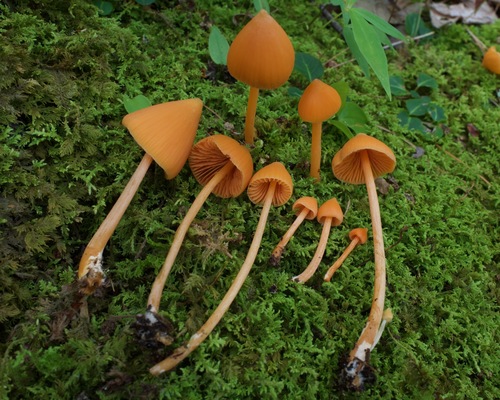
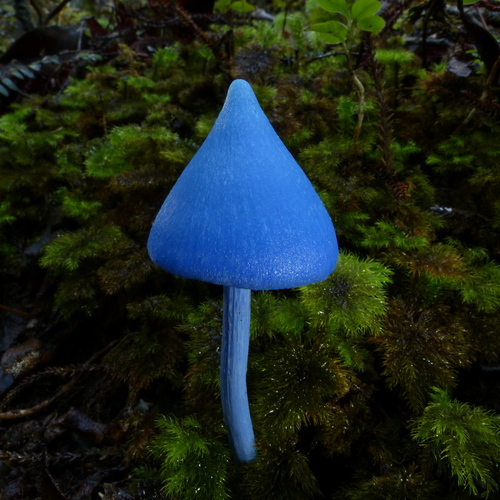
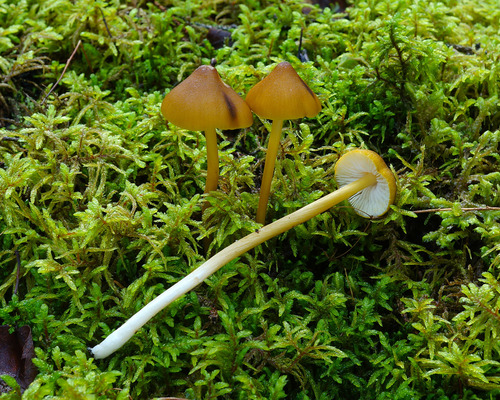
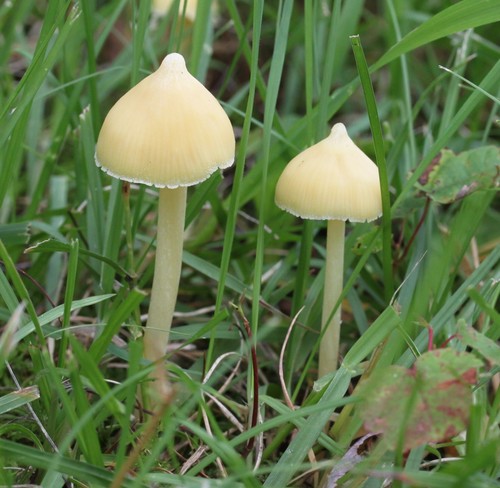
Entoloma murrayi (Berk. & M.A.Curtis) Sacc. & P.Syd. has a bell-shaped to conical cap that ranges from 1.3–3 cm (0.5–1.2 in) in diameter, with a distinct sharp umbo at the center. The cap is colored bright yellow to orange-yellow, and it typically fades as the fungus reaches maturity. The gills have a narrowly adnate attachment to the stem, and are spaced well apart. They are yellow when young, and develop a pinkish tint as spores mature. The stem is slender, hollow, 4–7.5 cm (1.6–3.0 in) long, and roughly equal in width along its entire length. It is pale yellow with a fibrous surface, and is often twisted with longitudinal striations. The stem surface is smooth, and a patch of whitish mycelium may be present at its base. The flesh is thin and pale yellow. The taste and odor of the fruit bodies are recorded as either pleasant or indistinct. The spore print is salmon-pink. Individual spores are smooth, angular (four-sided), hyaline (translucent), and measure 9–12 by 8–10 μm. Hyphae in the hymenophore tissue are arranged in a pattern ranging from parallel to interwoven, and are inamyloid. In the cap cuticle, hyphae are interwoven radially, or arranged in somewhat erect bundles. Clamp connections are rarely present on the hyphae of this species. The cap and gill tissue contain specialized repository hyphae, which are storage structures that hold metabolic byproducts; these hyphae release a watery yellow liquid when the fungus is injured. These distinctive hyphae can be observed via light microscopy in both fresh and dried specimens. Entoloma murrayi is a saprobic species, meaning it gets nutrients by breaking down organic matter. Its fruit bodies grow in wet coniferous and deciduous forests, appearing singly or in small groups on the ground in litterfall, humus, or moss. Fruiting takes place in summer and autumn. In North America, the species occurs in eastern Canada's Atlantic Maritime Ecozone, the eastern United States (ranging from Maine south to Alabama and west to the Great Lakes), and Mexico. Its distribution also extends to Central America, South America, and Southeast Asia, and it has been recorded from Jamaica and the Dominican Republic. The edibility of Entoloma murrayi is unknown, and it may be poisonous.