About Entoloma hochstetteri (Reichardt) G.Stev.
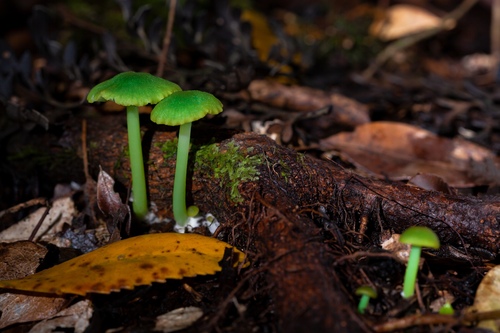
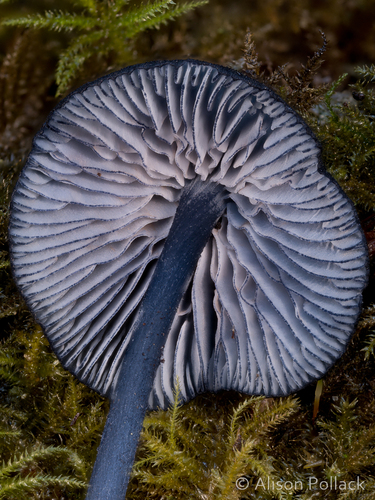
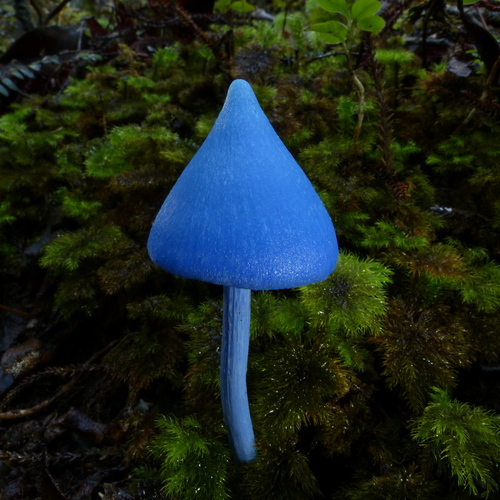
Entoloma hochstetteri produces small, delicate above-ground fruit bodies (basidiocarps). Its cap can reach up to 4 cm (1.4 in) in diameter, with a conical shape, an indigo-blue colour with a green tint, and a fibrillose texture. The cap margin is striate and rolled inward. Gills attach to the stipe in an adnexed or emarginate pattern; they are thin, 3–5 mm wide, match the cap's colour, and sometimes have a yellow tint. The cylindrical stipe (stalk) grows up to 5 cm (2 in) long and 0.5 cm thick, it is fibrillose and has a stuffed interior. This species produces a reddish-pink spore print. Its spores measure 9.9–13.2 by 11.8–13.2 μm, are tetrahedric in shape, hyaline, smooth, and thin-walled. Basidia measure 35.2–44.2 by 8.8–13.2 μm, are club-shaped, hyaline, and bear two or four sterigmata. This fungus is common across forests of New Zealand, where it grows on soil among leaf litter in broadleaf/podocarp forests, and produces fruit bodies from January to July. It has also been reported from India (in 1989) and Australia, but it remains unclear whether these records represent the same species, or if E. hochstetteri is endemic to New Zealand. All attempts to cultivate this species in a laboratory setting have been unsuccessful. While many other species in the genus Entoloma are poisonous, the toxicity of E. hochstetteri is currently unknown. Researchers are investigating its gene cluster responsible for blue pigmentation, to see if it can be used to produce a natural blue food dye.