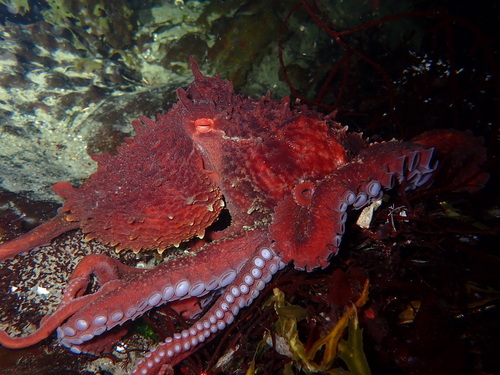
About Enteroctopus dofleini (Wülker, 1910)
The giant Pacific octopus, also called the North Pacific giant octopus, has the scientific name Enteroctopus dofleini (Wülker, 1910). It is a large marine cephalopod that belongs to the genus Enteroctopus and the family Enteroctopodidae. Its range covers most of the coastal North Pacific: it extends from Baja California, a Mexican state, north along the West Coast of the United States (including California, Oregon, Washington, Alaska, and the Aleutian Islands), and through British Columbia, Canada. It continues across the northern Pacific to the Russian Far East (including Kamchatka and the Sea of Okhotsk), and reaches south to the East China Sea, the Yellow Sea, the Sea of Japan, the Pacific east coast of Japan, and waters around the Korean Peninsula. This octopus can be found from the intertidal zone down to a depth of 2,000 m (6,600 ft), and it is best adapted to colder waters that are rich in oxygen and nutrients. It is the largest known octopus species on Earth, and besides living in the ocean, it is often held in aquariums and research facilities. E. dofleini plays important roles in maintaining deep-sea ecosystem health and biodiversity, supporting cognitive research, and contributing to the fishing industry. Unlike most other octopus species, which typically only live around one year, the giant Pacific octopus has a lifespan of three to five years. They reach sexual maturity between one and two years of age. Gonadal maturation is linked to the octopus's optic gland, which functions similarly to the vertebrate pituitary gland. These optic glands are the only endocrine glands identified in octopuses, and their secretions contribute to reproduction-linked behaviors and senescence. If an optic gland is removed from a mature brooding female, she will stop brooding her eggs, resume feeding, gain weight, and live longer than brooding females that retain their optic glands. To compensate for its relatively short lifespan, the giant Pacific octopus is extremely prolific. A female can lay between 120,000 and 400,000 eggs. Each egg is coated in chorion, and the female attaches all eggs to a hard surface. The female exclusively provides intensive care to the spawn, continuously blowing water over the eggs and grooming them to remove algae and other unwanted growth. While caring for her spawn, the female stays near her eggs and never leaves to feed, which leads to her death shortly after the young hatch. The female dies of starvation, as she sustains herself on her own body fat during this approximately 6-month period of parental care. When they hatch, young giant Pacific octopuses are about the size of a grain of rice, and very few survive to reach adulthood. Their growth rate is very rapid: they start at 0.03 g (0.0011 oz) and grow to 20–40 kg (44–88 lb) when they reach adulthood, which translates to a growth increase of around 0.9% per day. Giant Pacific octopus growth over a full year follows two seasonal phases: faster growth occurs from July to December, and slower growth occurs from January to June. As ectotherms (cool-blooded animals), they can use most of the energy they consume for body mass gain, respiration, physical activity, and reproduction. During reproduction, the male uses his specialized arm called a hectocotylus to deposit a spermatophore (sperm packet) more than 1 m (3.3 ft) long into the female's mantle. In male giant Pacific octopuses, the hectocotylus is located on the third arm, and makes up the last four inches of the arm. This section of the male arm does not have any suckers. Large spermatophores are a characteristic trait of octopuses in the genus Enteroctopus. The female stores the received spermatophore in her spermatheca until she is ready to fertilize her eggs. One female held at the Seattle Aquarium was observed retaining a spermatophore for seven months before laying fertilized eggs. Both male and female giant Pacific octopuses are semelparous, meaning they only complete one breeding cycle during their lifetime. Analysis of egg clutches has found evidence of both polygyny and polyandry in giant Pacific octopuses, where both males and females mate with multiple partners. This multiple paternity may allow females to increase the chance that at least one of her mating partners will produce viable, fit offspring. After mating, both males and females stop eating and eventually die. After reproduction, they enter senescence, which brings clear changes to their behavior and appearance: these changes include reduced appetite, retraction of skin around the eyes that creates a more pronounced eye appearance, increased uncoordinated activity, and white lesions covering the body. While the duration of this senescent stage can vary, it typically lasts around one to two months. Although active senescence mostly occurs in this period right after reproduction, research shows that senescence-related changes can begin as early as when reproductive behavior starts. In the early stages of senescence, which begin when the octopus enters its reproductive stage, individuals show hyper-sensitivity, overreacting to both noxious and non-noxious touch. When they reach late senescence, individuals show insensitivity to touch, alongside the dramatic physical changes described earlier. Changes in touch sensitivity are caused by decreasing cellular density in nerve and epithelial cells as the octopus's nervous system degrades. Death is usually linked to starvation for females, who stop hunting to protect their eggs; for males, death often occurs because they spend more time in open water, making them more likely to be preyed on. Increased seawater temperatures raise octopus metabolic processes. Warmer water leads to faster development and hatching of octopus eggs. After hatching, paralarvae swim to the surface to join other plankton, where they are often preyed on by birds, fish, and other plankton feeders. Quicker hatching can also disrupt the critical timing of food availability for newly hatched paralarvae. One study found that higher water temperatures accelerated all stages of reproduction and even shortened the octopus's total lifespan by up to 20%. Other studies agree that warming climate scenarios are expected to lead to higher mortality rates for both embryos and paralarvae.

