About Entacmaea quadricolor (Leuckart, 1828)
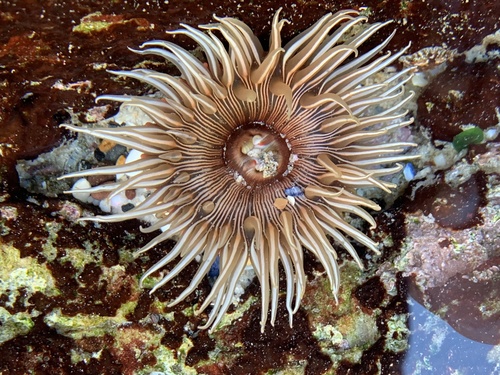
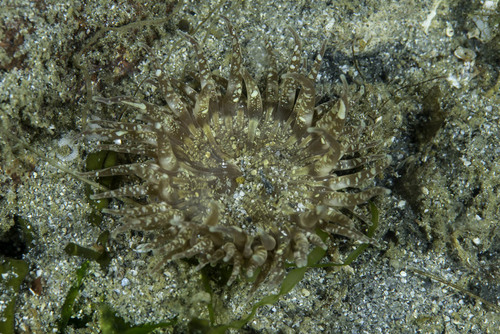
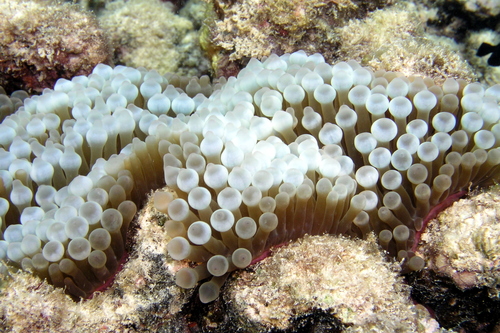
The bubble-tip anemone (Entacmaea quadricolor) is a species of sea anemone in the family Actiniidae. Like several other anemone species, E. quadricolor can support multiple anemonefish species, and displays two distinct growth types based on where it lives in the water column. One of these growth types gives the species its common name, due to the bulbous tips on its tentacles. Entacmaea quadricolor is widespread throughout the tropical waters of the Indo-Pacific area, including the Red Sea. E. quadricolor anemones appear in a variety of color morphs, including rose, orange, red, and standard green. This sea anemone can grow up to 30 centimetres (0.98 ft) in diameter, and obtains the majority of its energy from solar radiation via its symbiotic zooxanthellae. A key characteristic of E. quadricolor is its symbiotic relationship with anemonefish. The anemone provides anemonefish with shelter, while the anemonefish provides the anemone with defense against predators and some nourishment. The anemone gets additional nutrients by filter feeding with its sweeping tentacles, or processing wastes and debris cleaned from the surface of its partner anemonefish. In the wild, E. quadricolor occurs in two habitat locations. Large adult specimens, with more streaming or stringy tentacles, are often found in deeper, dimly lit waters, and these specimens are usually solitary. Smaller, younger specimens are often located in groups or colonies closer to the surface, in bright sunlight. These specimens typically have the characteristic bulbous tentacle tips that give the species its common name. The development of these characteristic bulb tips depends on several factors, including water flow, light, bacterial count, color, and whether the anemone is hosting anemonefish. When kept in home aquariums, medium flow and medium lighting are sufficient if the tank is old enough to support anemones. E. quadricolor uses a range of reproductive strategies. The most common strategy is a form of sexual reproduction called broadcast spawning, which is considered the main form of reproduction for the species. For individuals in eastern Australian waters, this spawning occurs at the start of the year between January and April. During this time, E. quadricolor releases its gametes into the water column, where gametes combine to produce free-swimming planula larvae. These larvae have been observed to survive up to 59 days in the water column, with peak settlement occurring around 10 days. This time spent floating in the water column allows for greater dispersal and increases genetic diversity for the species. Once the larvae settle, they begin further development and start the life cycle again. E. quadricolor can also reproduce asexually. For most anemone species, asexual reproduction may happen by pedal laceration, longitudinal fission, or transverse fission. E. quadricolor only occasionally reproduces asexually via longitudinal fission, and this occurs only on rare occasions. This form of reproduction allows quick reproduction of successful genotypes, but also leads to genetic isolation and reduced dispersal, since new individuals are likely to attach to the first hard surface they encounter.